Five Toe Joe
Surfing again has reconnected me to a part of myself I thought was lost. Just sitting out there on the board, legs dangling, hand pushing through the surf, listening to the sounds of the ocean I felt whole again.

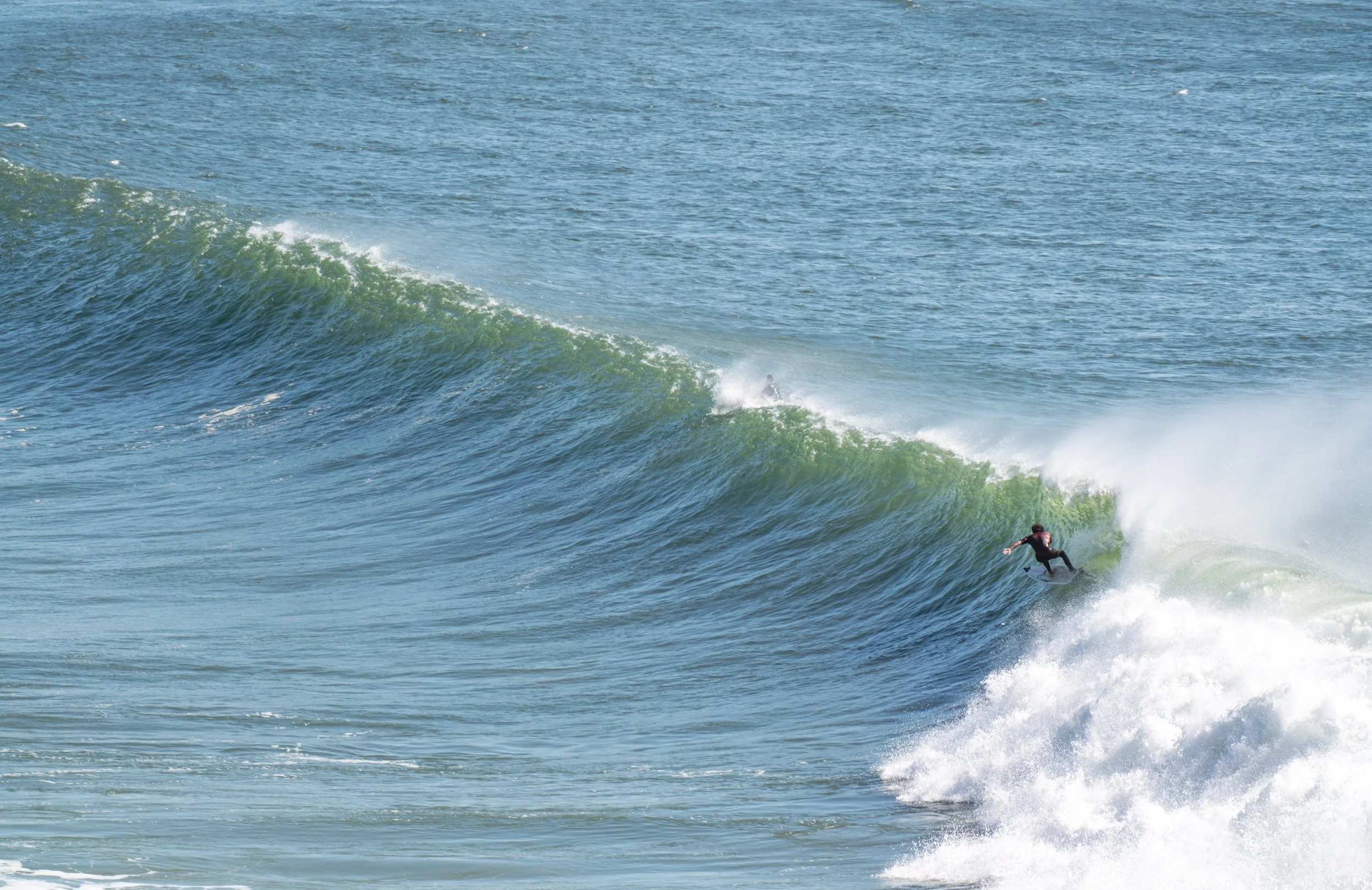
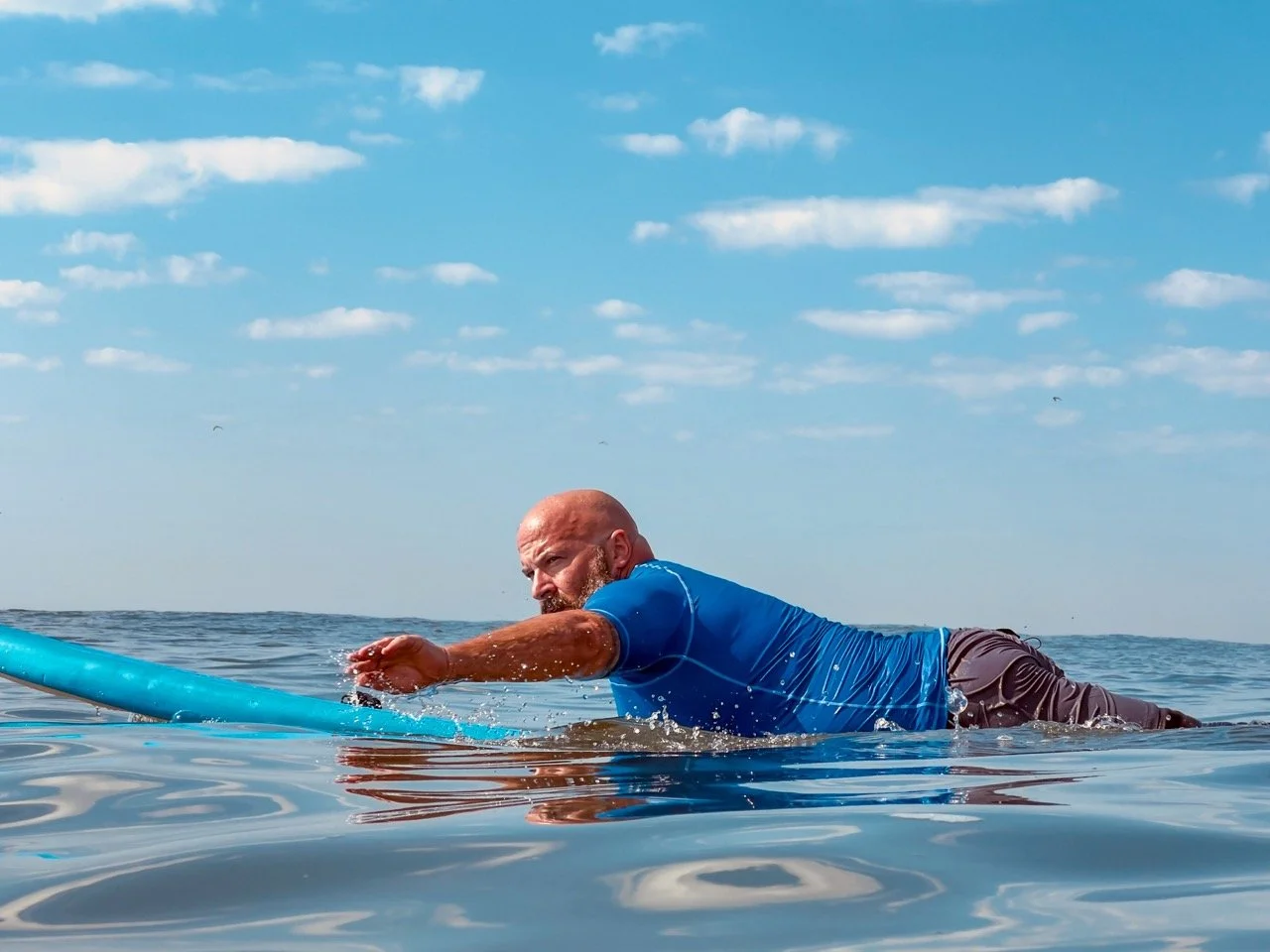
Joseph “fivetoejoe” Glascott surfing in July at the AmpSurf event in Rockaway Beach, New York City
It’s a sunny Saturday morning in July. The water is warm, right around 70 degrees, and the sweet sound of yews echo up and down the beach. I’m swimming around surfers and AmpSurf volunteers, working hard to capture the pure joy of the moment. Bill’s out in the water too, shooting video. I turn my camera towards the jetty, playing with the uptown light, and at once I notice a surfer sitting in the lineup. We quickly start this dance: he gets in position, I get into position. It feels really familiar, and I wonder who he is. I’m guessing maybe he’s a volunteer who decided to catch a quick wave or two before things really got going. I shoot him turning the board around and then his arms paddling as drops of the ocean fall from his fingertips. His face is serious and focused. He spots his wave, paddling into it as the volunteers nearby make room, and we all watch and yell in unison. As I photograph him pop up close to shore, I realize at once he’s not a volunteer; he’s one of the participants. Like all the surfers I know and love, he gets right back on the board, and paddles back out. I shoot him as he glides through the water, the two of us making eye contact as we head farther out. Some of the volunteers circle around him, in awe of how well he surfs. I hear pieces of his story as he talks about his relationship with surfing—I’m certain I hear him say it’s been twenty years since he’s been back in the lineup.
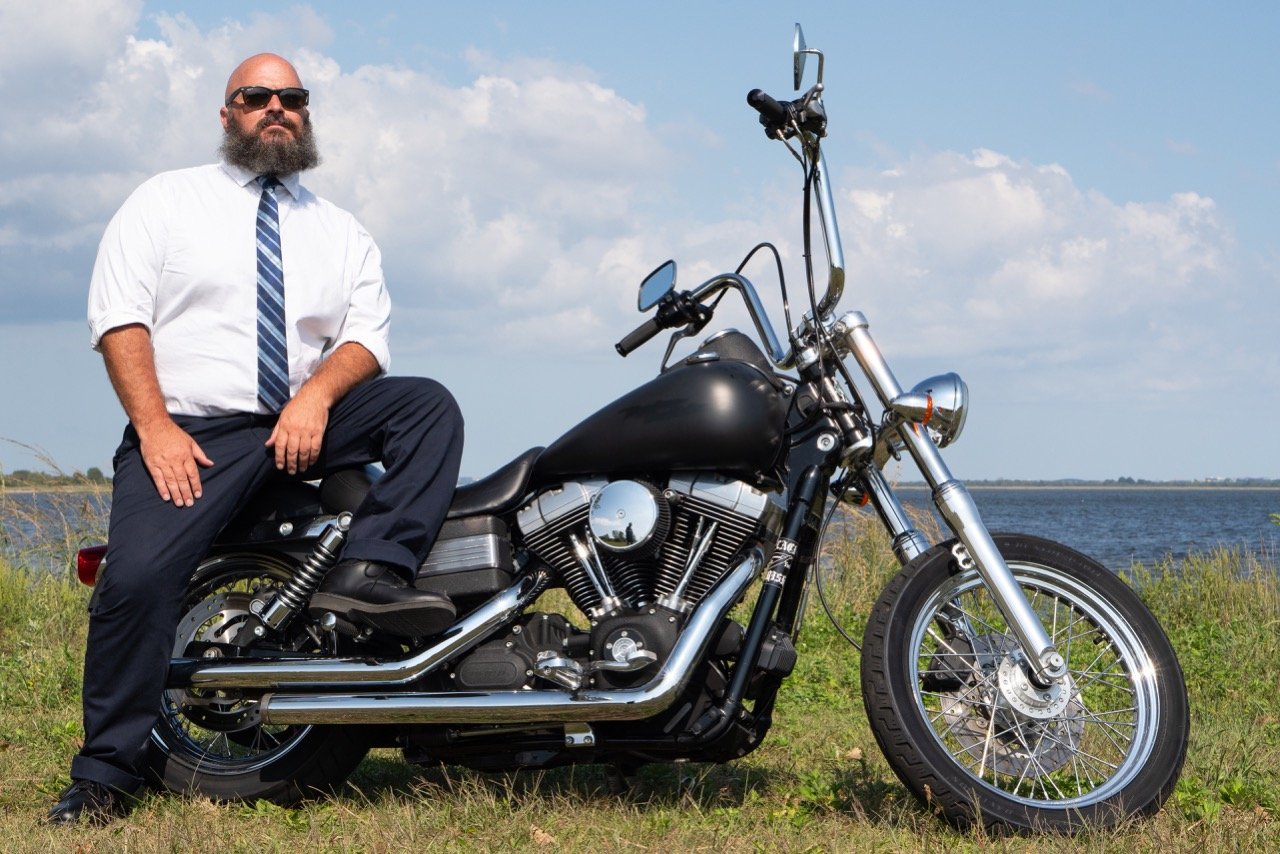
A few weeks later, Joseph Glascott, driving his beloved Harley, meets up with Bill and me at Floyd Bennet Field. It’s surreal seeing the bike in person now that I know more of the story and how his motorcycle plays a key role. Joseph wears a white button down shirt and dark dress pants, a navy-blue patterned tie and pocket square tucked away in his backpack. It’s always weird to see a surfer in “street clothes.” I’ve photographed him before, and we’ve been talking often. It’s interesting doing photo shoots with friends, and he’s definitely my friend now. The three of us can’t stop laughing as we move around the location to unique spots I’ve scouted just for this day. At once, I see that this isn’t his first photoshoot. He’s mastered poses, knowing exactly how to position himself, just like in the water. I give little direction. He smiles and tells me he has a bit of experience with modeling/acting; he was in a Hot Wheels commercial back in the day. Bill is beyond excited! Later back home as we’re talking about what a unique shoot it was and how much fun we had, Joseph sends me a text. It’s the commercial. As we watch it several times with ear to ear grins, I think about him as a little kid, growing up, as he told me, surrounded by positivity, a lesson handed down from his Dad and a quality you notice the minute you talk to him. Like every great teacher, Joseph’s taken that inherited positivity, applied it to his own life, and freely paid it forward to the next generation and all of us lucky enough to call him friend.
When and where did you first start surfing?
JG: I started surfing, boogie boarding actually, when I was about 14/15 years old down at the West End 2 jetty. Started learning how to catch waves and the general rules of the line-up. Back then WE2 was pretty territorial so you had to learn fast. The next summer I borrowed my cousin's board, a 6’2 trifin thruster, that was hanging in my grandmother's garage, and paddled out for the first time. After that day I was hooked. It was tough learning at WE2 since I'm goofy foot and soon made Gilgo my home surf spot. Eventually, I moved up to an 8ft locally shaped board from a shop called Phoenix and often borrowed friends longboards down where we were at.
Has water always been important in your life?
JG: The ocean became a shaping force in my young life. It provided me with many of the lessons young men need to learn at that age, like patience, humility, and the love of the natural world. It also taught me how to challenge myself, not allow fear to hold me back. The more time I spent in the water the more I wanted to learn about it and eventually got involved with ocean and environmental issues on Long Island.

Surfing again has reconnected me to a part of myself I thought was lost. - Joseph
When did you learn about Amp Surf?
JG: I learned about AMPSURF from my girlfriend Kailey. She had listened to me talk about the good ol’ days of surfing back before I lost the leg and how much it meant to me and my life. She started asking why I didn’t surf anymore, and I listed all the reasons I gave away my board and why it was an impossibility in my current condition. This made her laugh because of the fact that riding motorcycles again was never in question, but for some reason surfing again seemed like an impossible task. So apparently there is this thing called Google, and she typed in amputee surfing, and Ampsurf was the first result to pop up. She wanted to surprise me by signing me up as a birthday gift but wasn’t sure if I would be into it. Needless to say, I was blown away by the thoughtfulness of the gift and that she believed I could do this even when I didn’t.

The loss of my leg and my new status as an Asymmetrical American™ 🤣 was brutal at first. - Joseph
Joseph, how did you lose your leg?
JG: I lost my leg in a hit-and-run motorcycle accident in Oct of 2008. While riding home from a friend's house, someone ran a stop sign, hit me off the bike and left me for dead in the street. They didn’t amputate the leg that night like they should have since my vascular sys in the leg was destroyed. I spent the next two months in the hospital. After eight or nine surgeries, the doctors said all they could do was keep cutting back the infected areas, and that's when they told me I had to make the decision to either keep going or to amputate the leg below the knee. It was the most difficult decision I had ever had to make, but understanding my situation could get worse if I didn’t, I made the choice to have them go ahead and remove the leg.
How has your life changed because of that loss?
JG: The loss of my leg and my new status as an Asymmetrical American™ 🤣 was brutal at first. The only thing that kept me going and in positive spirits was the love and support from my friends and family. That may seem cliche but it is the absolute truth. If it wasn’t for them, I wouldn't be here today. Recovery was steady but slow. I returned to work in January of 2009, even before I had my prosthetic. I am a school Librarian and missed my students. Getting back working with them helped a lot too. Once I healed up I started working with a great company called International Prosthetics and Orthotics. After a year or so with the help of a cane, an Irish Blackthorn to be specific, life started to get back to normal, or at least the new normal. I had to learn how to do many of the simple things of daily life all over again with consideration of the leg and balance and how to deal with the pain once I weaned myself off of the Dilaudid. One thing that didn't change was my love of motorcycles. I was up riding again in the fall of 2009. Yet, for some reason, the idea of surfing again seemed an impossibility until recently when someone I have come to care for very much signed me up for the AmpSurf event.
Wow, so you got right back on your motorcycle without hesitation?
JG: There was never a doubt in my mind that I was going to ride again. It took me about about a year or so to be healed up and strong enough to ride, but my good friend Irish Rob told me whenever I was ready I could take out one of his bikes. I spent a lot of time during my recovery at Rob’s house. So one day we were just hanging out, and the feeling, the need hit me. I asked Rob where the keys to Red were, red being his red ‘05 Sportser, and without hesitation he told me the keys were by the back door and that the garage was open. He didn’t make a big deal of it or even follow me out. He just let me have that moment to myself. I only rode up and down and around the block a few times that first time out, but in those few minutes I felt like I was whole again.
What was that like going back to work? How did your students and coworkers react?
JG: Going back to work was challenging. I didn’t have my prosthetic yet and had to get around on my crutches and it was obvious that something was “missing.” At the time I was working at the Jr High School and the kids, like most kids, asked all the odd and awkward questions that only kids will ask and it was great. They were like, “sucks you lost your leg. Can I see it?” They had no pity, just empathy and curiosity.

Tell me about the idea of using the nickname Five Toe Joe.
JG: The nickname FiveToeJoe was given to me by my long-time friend and riding partner “Irish Rob.” Much of my recovery was spent at Rob's house in the garage working on motorcycles, drinking beer, and talking shit. Rob likes to break balls and bust chops and on one particular day we were carrying on about something ridiculous when he said “Hey five toe, let’s go.” Embracing the name helped turn something tragic into something of an identity to be proud of. Being disabled wasn’t something I was going to be ashamed of. So I embraced it head on, and FiveToeJoe was born.
Did you decide right away you were going to participate in the AmpSurf event?
JG: As soon as Kailey told me about it I was in. I did have some questions about whether or not someone with a below-the-knee prosthetic could participate. After a quick email to Dana, the founder of AmpSurf, I was assured that the coaches and volunteers would absolutely be able to accommodate my handicap and get me surfing again.

I never thought I would be able to pop-up and surf again.
For the first time in twenty years, you were back in the line up. That was such a heavy statement to hear you say. Can you describe what that was like? Physically? Emotionally?
JG: Physically, it was a serious challenge, but the joy and adrenaline of being out there again kept me energized and paddling out for just one more wave every time I rode one in. I’ve found it difficult to work out over the years without getting hurt and wanted to get back into the water just for the workout. I never thought I would be able to pop-up and surf again. Emotionally, it is still tough to describe. I love being in the ocean. About a year ago I had my prosthetists at IPO make me a water leg so that I could walk into the ocean again. The idea of taking my leg off and floundering into the water was something I was embarrassed about. I had finally come to the point where I wanted to get more out of life and start getting back to doing things that brought joy to my life. On my 45th birthday, I was at my house in Maine and walked into the ocean for the first time since 2008. It was an emotionally overwhelming experience. Being in the ocean and connecting to something so much larger than oneself was a power I had not felt in a long time. Still, the idea of surfing was something I couldn't even imagine. It took the faith of someone I love to convince me I could do it. And because of that faith and belief in myself, I had one of the best days of my life with AMPSURF and plan to continue to keep getting out there.
How has surfing again affected you?
JG: Surfing again has reconnected me to a part of myself I thought was lost. Just sitting out there on the board, legs dangling, hand pushing through the surf, listening to the sounds of the ocean, I felt whole again. Also, rising to the challenge and accomplishing something I truly thought was impossible has motivated me to get out there more and challenge myself with other things I thought were out of reach.
Do you plan on surfing more?
JG: I absolutely plan on surfing more. I already started saving for a new board and hope to be back in the water next spring if not sooner.
If someone is considering participating in an event with an organization like Amp Surf, what kind of advice or words of encouragement would you share with them? What can they expect? And how do they push through the fear?
JG: AmpSurf is an incredible organization. From my early questions, to getting in the water, I felt supported the whole time. The event was well organized and every person involved was kind, friendly, and had so much genuine encouragement. I felt like there was no way I could fail. I would encourage anyone, regardless of their disability, to participate in an AmpSurf event. I felt safe and supported while on the beach receiving instructions to being in the water with the coaches and all of the amazing volunteers. So much so that I hope to be able to volunteer in any way I can at some of next year's events.


The idea behind The Wild Journal is living a life that’s connected to nature, the outdoors, and water, being totally aware of its importance. Wild means something different to everyone. What does wild mean to you?
JG: To me wild means freedom. Free to connect with who or whatever you love. Free to express yourself, and free to create the world around you. But something that is wild is also something to be respected, honored, and revered. The ocean and the world around us should be respected for its unique beauty and power. There is nothing so humbling as getting lost in the woods or being pounded by a wave to make you feel humble to the majesty that is Mother Nature.
You recently celebrated your birthday with a trip to Paris during the Olympics. You look happy and like you fit right in to the Parisian vibe. Is that a trip you’ve always thought about?
JG: I’m my wildest imaginings I would never have believed that I would get to celebrate my birthday in Paris, France with a woman for whom I have come to love so dearly. It was not a trip I had ever planned on taking, but it was the perfect birthday and trip I will not soon forget.
Do you celebrate birthdays differently since your accident?
JG: Not really. Birthdays have always been low key events for me. As I said earlier, with the love and support of my friends and family birthdays and holidays were always joyous events. Being asymmetrical didn’t change that.

Joseph, what are two or three things you know for sure?
JG: 1. Shit Happens 2. Compassion is the Way 3. With love, life is simple, anything is possible


A Beautiful Purpose
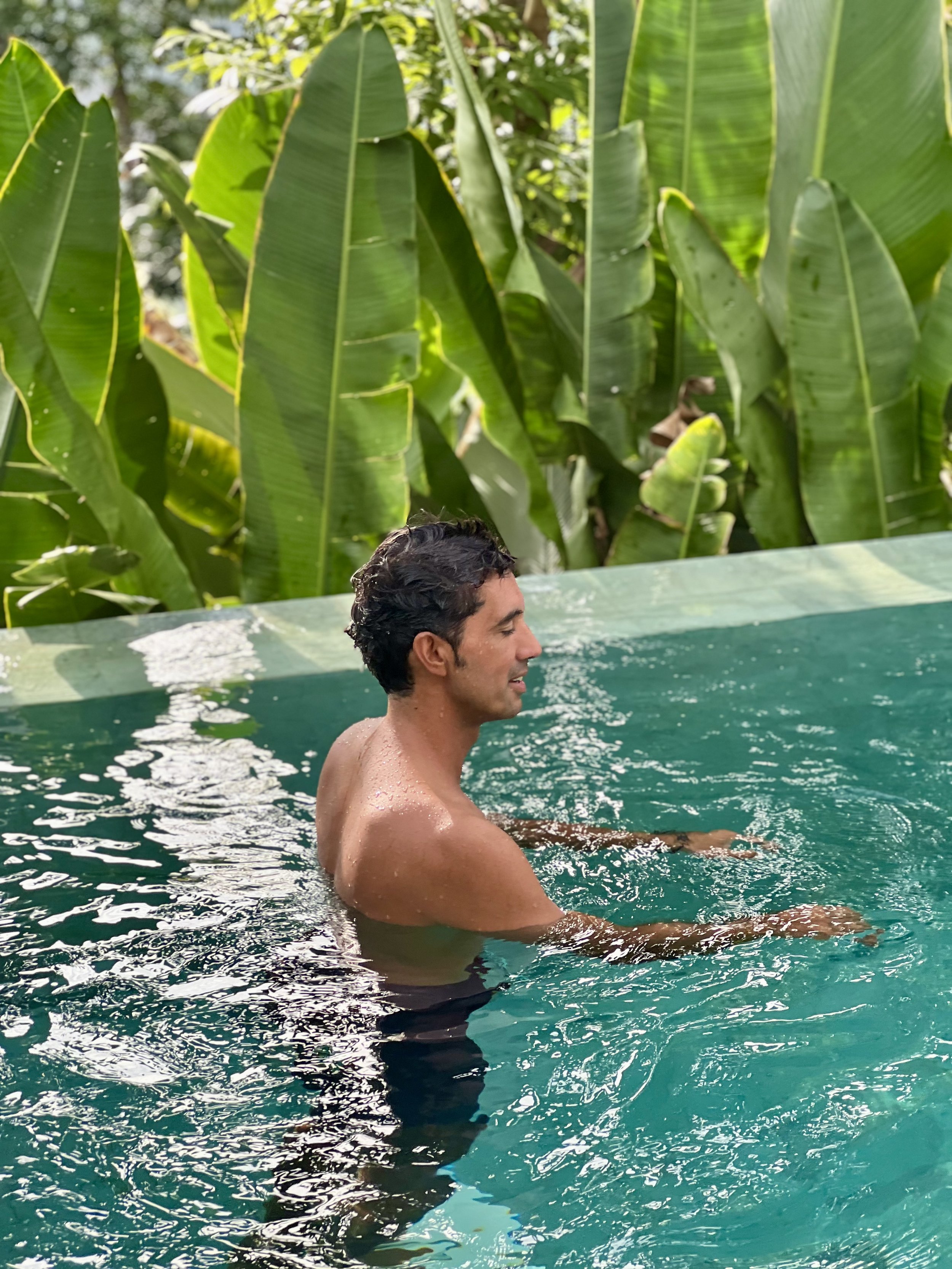
To build the conditions for people to rest their minds and bodies and to enjoy something as wonderful as surfing and yoga, it’s a beautiful purpose.

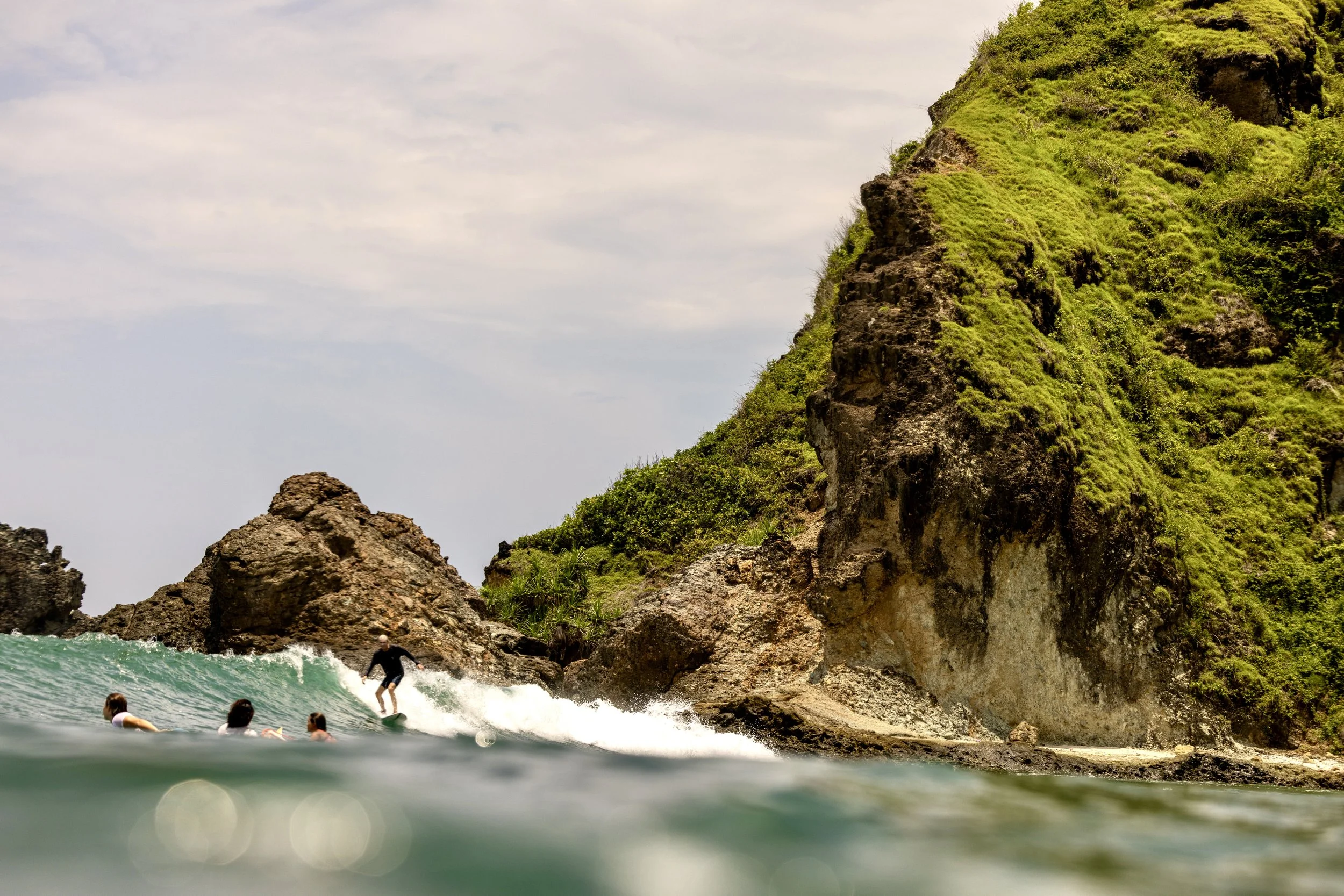
Jose riding waves at Kuta Beach
Jose’, Thank you so much for doing this interview with me. We’ve only known each other for a few months, but I can honestly say it feels like I’ve known you my whole life. I felt an instant connection to you, and Bill did too. I know a lot of people must feel the same when they meet you. You simply radiate as a person. I believe we will see each other again soon. Maybe in Lombok, maybe somewhere else, but definitely it’s our destiny to reconnect in the near future, and I look forward to that day.
My good friend, thank you for choosing me to help you with this task. Please excuse me for taking a bit of extra time to complete it but some questions I wanted to think deeply before answering them. I also felt a warm and kind connection with you and Bill. I admire couples that have endured time and life challenges and you can still see crystal clear how they love each other, like you two. An inspiring couple for me. I'm also sure we will meet again, don´t know where, but we will. Until then, we will keep in touch thanks to the tools that technology has given to us. Take care of yourself! A big hug for both of you, José
Travel lies at the heart of our connection in Indonesia. What role has travel played throughout your life?
JRG: To travel it has been a new discovery. I have traveled a bit in my life but always were “easy trips”, like going to Disney or close to Chile. It was just in 2020 when I went to an unusual destination such as San Juan del Sur, Nicaragua, and immediately I felt that something changed or woke up in me. In this part of my life, travel has helped me to trust in myself, to broaden my perspective and because of this, to value even more the differences between people. Curiously, and that's another reason for me to believe that I'm at the right place, the Indonesian motto is “Bhinneka Tunggal Ika” which can be translated to “unity in diversity”.

Just a few weeks ago you celebrated your one year anniversary with Xanadu. Congratulations! I would’ve guessed you’d been there much longer. You seem as if you’re one with the property. Can you tell the story about how you came to Xanadu and eventually ended up starting your life and career over in Lombok?
JRG: I think we all are quite connected with the vision. Probably Xanadu is a common dream of everyone who works here. I just happen to be a more visible face for the guests. But I'm just another piece in a network of a hard-working committed team.
After 10 years of working in politics and teaching at my law school I decided to do a long solo trip. Wanted to know historical places and to learn how to surf properly. So I went to Europe for three months and then I came to Indonesia for three months, mainly in Uluwatu by then. But I'd heard about this magical island where the surf is great. So I was a guest at Xanadu Village in August 2022. I could see that the weekly package was well organized and structured, made for improving your surfing. I got to know Ola, one of the owners, because we have a friend in common. And I could recognize an admirable strong woman with the will to build an honest business, with purpose and a compass. Out of a joke we started thinking on the idea of me being the host, since she wanted to have someone thinking about the guests, whilst the surf and staff areas were covered by two great persons: Kayan and Ton.

Do you ever miss that other life? The suits? The formality? Any of it? How were you able to let go of that life, what you knew, to provide space and fearlessness to start a new life?
JRG: I´ll always miss serving my country and working with people committed to build a better, free and fair society. Politics were invented to improve people's lives. Here at Xanadu my role, in a whole different scale, kind of looks like that. My goal here is to improve our guests' experience and I'm surrounded by people who honestly care about giving good service. To build the conditions for people to rest their minds and bodies, and to enjoy something as wonderful as surfing and yoga, it's a beautiful purpose.

Do you think of it as beginning again? Or as an extension of your past life?
JRG: It is a whole thing. I couldn´t be doing what I'm doing without that experience. Aren't we all our history as well? We are in the present who we were in our past. And it's up to us how we want to be in the future.
In the US it’s normalized to think a career choice and job defines us. Is that the same way in Chile’? Europe? Asia? Do you see yourself defined by your job? Or is it different for you? What’s your relationship with a career or job?
JRG: There is dignity in working, aiming for excellence. You can see people's ethics in their performance at their jobs. I don´t think your career defines you as I don't believe society tells you what to do or not. It is us, and our thoughts that shape us. We are free as we are responsibles.

You have an ease about you, a light. Everyone staying at Xanadu during the workshop was drawn to you. You always had a smile on your face. Have you been like that your whole life? Or is that something that’s grown out of living your best life?
JRG: Riley, you are too kind with me haha, thanks for these thoughts. Though I have to say that thankfully we were in a very nice group, everyone was happy, bonding, learning. It's a conducive environment to be smiling.
I celebrated my birthday during my stay at Xanadu. You guys surprised me with a cake and everyone sang Happy Birthday. I usually hate being the center of attention, but I must admit, it was pretty darn special to look over at you and all of my workshop buddies smiling and singing. I’m guessing you are a part of many special moments like that with guests. Are there any moments that stand out?
JRG: I think my favorite moments are during the video analysis that Kayan does every week. To see everyone looking carefully at their performance, huge smiles everywhere, cheering when someone was paddling hard and finally got the wave. To see a group of strangers enjoying a shared time is a beautiful thing to see.

Your love for the ocean provides a special connection to your Mom. Could you talk more about that?
JRG: I´d like to say that the ocean is a huge connection for humanity. We all can connect through the sea. The fact that we surf the energy that was released thousands of kilometers away talks about connecting, right? And for me, family and friends are the most beautiful connections ever, made out of love. And the love from a mother is probably one of the most powerful energies ever.
Can you imagine a life without surfing now that it’s become an integrated part of you? What does surfing give you every time you paddle out?
JRG: Not at all. Surfing has come to stay in my life, hopefully. I don't want to live anywhere if I cannot surf there. I would say it gives me fun through challenge.

I remember Kayan showing me a photo of a drawing you did to teach yourself how to become a better surfer. It was so technical and unique, and I couldn’t stop looking at it. How exactly did you learn? What were the details of that drawing? I’m hoping we’ll have a copy of it to include in this piece. It was really phenomenal, and I loved hearing Kayan tell the story.
JRG: There are no secrets here. Just like everything you want to learn: studying, putting your heart on it and practicing. Discipline and time. And of course, a lot of luck on my end, since I ended up at a surf & yoga hotel, and getting to know an amazing and generous surfer as Kayan.
The drawing is from one of my favorites surfers: Laure Mayer. She is just outstanding and so graceful all the time (not only when she´s surfing). So to understand what my body needs to do to do a drop knee, I took a screenshot, brightened up the screen, put a paper on top of it and drew it.

You and I nerded out talking about Coleridge and Kubla Khan. It was wonderful (I don’t get to do that often!), and it was obvious you are passionate about literature, the arts, and philosophy. Who are your favorite writers? Favorite books? Any books you go back to often?
JRG: I'm not as educated as I would like to be but, in terms of poetry, my favorite is Mario Benedetti, from Uruguay (poems like Todavía, Te quiero and Soledades are just magnificent) and Gabriela Mistral from Chile (Nobel prize of literature in 1945). I also like Winston Churchill and his assertive sharp mind and his admirable vocabulary. A book . . . The first to come to my mind is “The Duelists” from Joseph Conrad. Elegant, fun. You can learn so much by reading it.
Can you tell me about Pedro?
JRG: I can tell you he taught me how to be a better human being. His bright smart eyes I will miss and remember through the years until I’ll go to him so we can play together again.

Jose’s beloved dog Pedro
When people ask about my trip to Indonesia, I always talk about the people. Everyone in Lombok and Bali welcomed me and made me feel right at home. They were all lovely and generous. When I saw monkeys in the wild for the first time, I was mesmerized. We were driving back from the beach, and the driver couldn’t believe I’d never seen them. He waved the other Xanadu truck behind us to go around so that he could position our SUV in a spot where I could watch and photograph the monkeys on the road and in the trees. It was a moment I’ll never forget, the monkeys and such thoughtfulness. I was so blown away by the moment, I forgot everything else, including the driver’s name. What stands out for you about Indonesia, and more specifically Lombok? Has it changed, and if so in what way, since your first visit?
JRG: His name is Rindan. And he, as people are here in Lombok, is such a kind person. That is one of the things that I like the most about Lombok, the kindness that people usually show you. A genuine friendliness in your day to day life.
Do you feel like you’ve found your wildness in Indonesia or in surfing and being in the water? What does Wild mean to you?
JRG: I like the thought of connection with nature. More than with Indonesia, even though Lombok is an amazing paradise, my connection with nature comes since I was a child and the house where I grew up in was full of different trees, a grapevine, really pretty. And then, when surf appeared, well, then I got to enjoy nature again as if I was a kid.

Do you have any advice you’d share with someone who’s thinking of changing their life, doing something completely different, whether it’s a relationship or a career, or trying something new?
JRG: I wouldn't dare to advise anyone. I just can say that it's been something positive in my life to chase what makes me happy.
What’s a day in the life for you?
JRG: It really depends on the day, but the common aspects of my week are checking on the guests to know how they are living their experience here with us at Xanadu. Therefore I try to be around, answer questions (from where can I go to a special dinner with my partner to how early should I arrive at the airport?).
I try to surf as much as I can, with the proper balance to have enough time to rest sometimes, and to do other things that I care about, like studying something or helping a friend with a wild journal :)
Jose’, What are two or three things you know for sure?
JRG: That life is beautiful and it will end. That it can change drastically any day without warning. That we are all going to die and so, in between, I want to aim for love in my living. Loving myself, my family and friends, my surfing and my job.



Living the Life of Riley
I moved out of the city and made my home in Rockaway, craving more of an outdoors lifestyle and the sweet sound of crashing waves. An empty nester, burned out, and emotionally distraught, I’d lost my way.
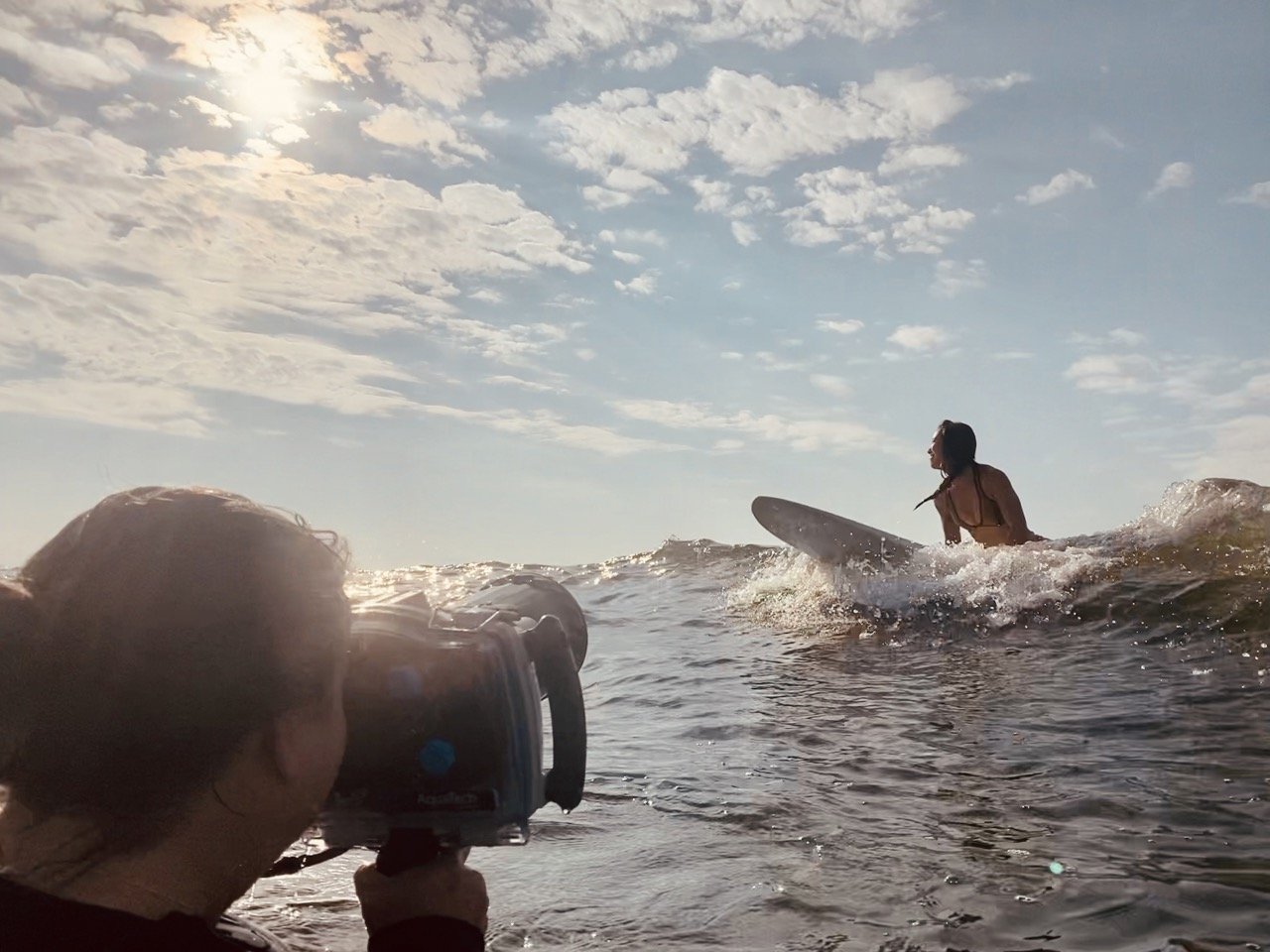
People always ask me what Life of Riley means. Simply put: It’s a declaration of living your best life. The concept was based on a 1944 radio show and later became a hit 1950’s TV show, The Life of Riley. People started using it as a common saying, that person is really living the Life of Riley, aka the good life. I first used Life of Riley as an artist name when I created my award-winning column at my college newspaper. It’s weird to say, but I became an instant sort of low-key “celebrity” around campus. Students started calling me Life of Riley or Riley. I’d get shout outs from strangers telling my what they enjoyed about my column or what it meant to them. I’d left my sales & marketing career behind in order to follow my dream of becoming a published writer. The end goal was an eventual MFA, and I wanted to write a book. So I attended college for the first time (I was a high school dropout.) at the age of 36. It was a huge leap of faith. I was scared a lot of the time, but writing the Life of Riley pushed me to explore and grow as a person and a creative. Those Life of Riley shout outs motivated me, maybe in a way nothing else ever had, and I savored each one. It was a sign that I was right where I belonged. That was life changing.
While in school, I joined the board of directors of a nonprofit. This was right at the beginning of social media. The nonprofit needed a Twitter account. I was the creative. So I learned all I could about Twitter and not only built that account but built the account of other locations’ social media. I really fell in love with the spontaneity, creativity, and even the crazy challenging algorithms. As a writer and a marketer, it came naturally. Once the word got around that I knew social media, other brands asked to hire me. So I started my own side hustle, Life of Riley Communications, a social media consulting company. I ended up growing a six figure business and made that my full-time career for almost a decade.

Five years ago, this past September, everything in my life changed. I moved out of the city and made my home in Rockaway, craving more of an outdoors lifestyle and the sweet sound of crashing waves. An empty nester, burned out, and emotionally distraught, I’d lost my way. Although I continued with a few clients, my heart was no longer in my business. I’d also started a book, but I realized at a certain point that I had run out of words. I picked up my camera that I normally used to create content for clients and started taking photos when I’d walk on the beach. At first it was seashells, seagulls, boats, and all the interesting beach characters. One chilly fall day, much like the weather as I’m writing this, a lone surfer caught my eye. It was just the two of us out there: not another soul in sight. I couldn’t look away and continued shooting, mesmerized by his long, smooth glide on the board and the hustle and flow of the Atlantic ocean. The sky opened itself up to me in a way it never had before. Oh what light! That dancing light even on a misty grey day took my breath away. I was reminded of days on the water when I was a kid, and how my little brother and I never wanted to get out or leave. And that was that. At 50, I reinvented myself as a surf and water photographer. Life of Riley NYC was born.

So, yeah, The Life of Riley means living your best life. But what does that even mean or look like really? I don’t have it all figured out. Hope I never do, honestly. I do know what I’ve discovered up to this point with all my Life of Riley iterations. I believe it means practicing self love or at least self like as often as possible. Recognizing daily joys like a sunrise. Connecting with people who support you and inspire you and reciprocating. Taking chances. Being gentle with yourself. Trusting the ebb and flow of life. Exploring where the comfort zone dead ends and adventure begins. Here’s to living your Life of Riley!