
The Sun and the Moon and the Stars
To be wild is to be yourself. For me, the hardest part of my journey has been loving every part of who I am—the good, the bad, and the messy.
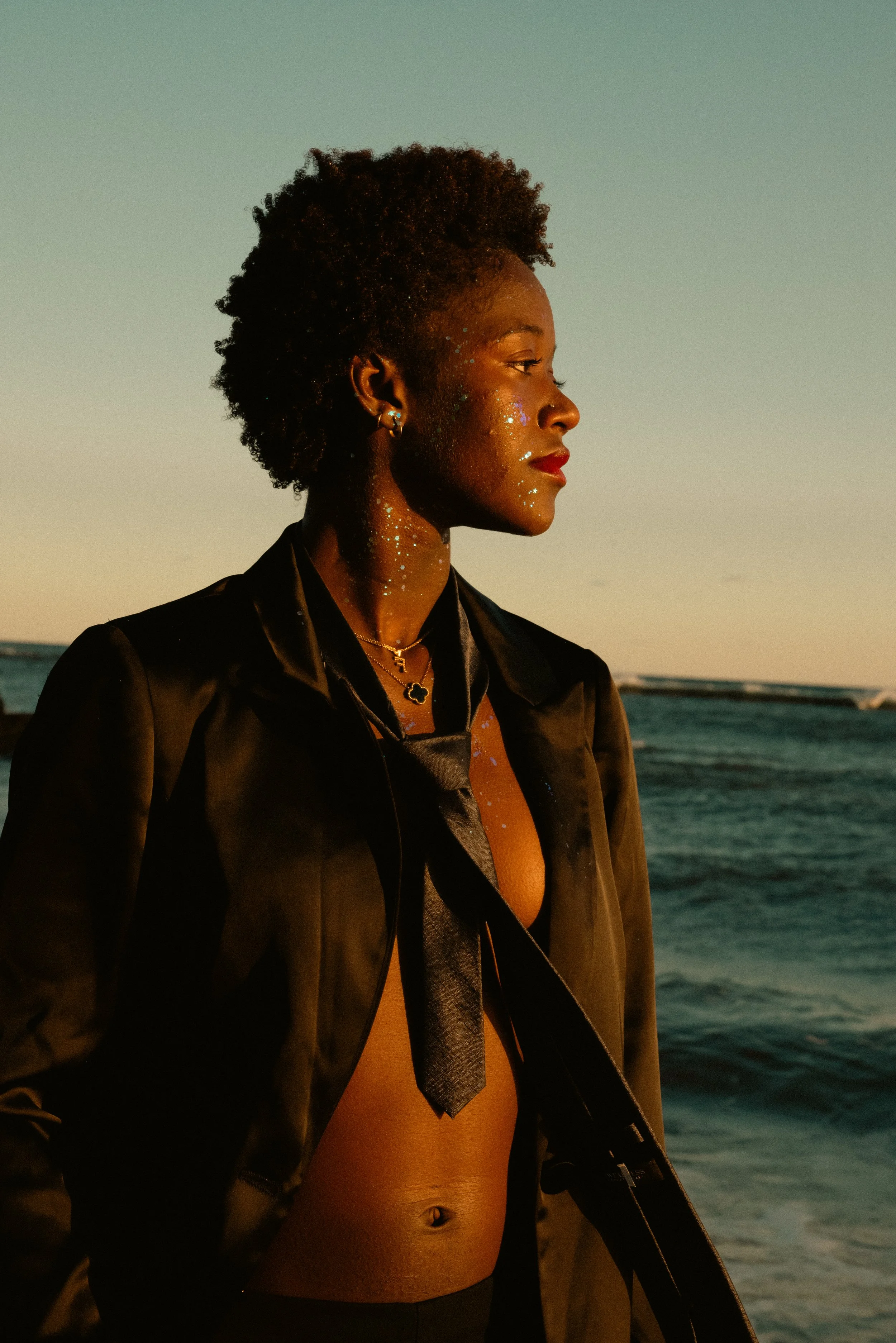
Farmata Dia, raised by Senegalese immigrant parents in Far Rockaway, New York, discovered her passion for surfing and mentoring through The Laru Beya Collective in 2016. Committed to empowering young women of color, she advocates for women’s rights, environmental justice, and community upliftment. As a mentor and model, she is breaking barriers and redefining representation in surfing, modeling, and skating.

“Really immerse yourself in the community. These days, it’s all about who you know more than what you know. It only takes one person to change your life or jump-start your career.”
Farmy and Rockaway are synonymous. She is as much a fixture in this intimate hamlet by the sea as dolphins, jetties, and surfboards. I’ve known her almost as long as I’ve been in Rockaway but honestly can’t remember what it was like not to know her. And as cliché as it is, to know Farmy is to love her. She’s fun, fearless, honest, quirky, and cool. Our friendship blooms in a constant drift of creative and personal growth. Farmy and I work together often, shooting surf, a film (still in the works), and numerous Laru Beya events. Always up for anything, she excitedly agreed to model for this surf culture meets fashion photo shoot in a unique to us beach location. We used my beloved Dry Robe changing robe as a dressing room and shot three different looks thrifted and styled by me. We started our shoot with a blood red Xscape cocktail dress, next a Shein satin baby blue cocktail dress, and wrapped up the late afternoon with a black Bebe blazer, Uniqlo dress pants, a black tie borrowed from my husband’s wardrobe, and a Fahizo silk bow tie. The last part of the shoot I added a little body glitter to play off the light from the sun and the moon, both competing as our backdrop, while Farmy stood tall among the dunes and butterflies danced around us.
*No dunes were touched as we only used established beach paths for our entire shoot.
You’ve been enjoying great success with your modeling career, shooting with cool brands and publications like Teva, Finisterre, Heroine Mag, and Teen Vogue. I’m always hyped when I see your photo pop up on brand pages. I’m wondering if you have a shoot that really stands out in your mind as momentous?

“ To be wild is to be yourself. ”
FD: My favorite shoot to date would probably be the campaign trip with Seea. We traveled to what felt like paradise and surfed some of the longest waves I’ve ever experienced—waves that made my legs burn, gave me time to think, and let me create incredible memories with beautiful people. While the surfing was incredible, it was the group I traveled with that made the trip so special.
My dream of surfing with one of my idols, Leah Dawson, came true. Leah truly embodies the art of surfing. The media crew was full of talented creatives who made shooting effortless, and the Seea team was inspirational with their hard work and dedication. Jo and Annabelle, the other winners, were so cool. Hearing their stories and realizing how we all ended up in the same place was such a unique experience.

Any advice for someone interested in modeling?
FD: My advice would be to start by building a portfolio. The first step is getting your digitals done. From there, connect with small photographers, stylists, and other models—really immerse yourself in the community. These days, it’s all about who you know more than what you know. It only takes one person to change your life or jump-start your career. Attend events, make sure people see your face, and post often on social media. Share fun things about yourself—it doesn’t have to be just photos. Videos showcasing your personality, adventures, or interests can go a long way.

Farmy models a Doyle Surfboard
What are some of your favorite brands you’ve worked with?
FD: Some of my favorite brands are Finisterre, Seea, Ricki Beach Club, Vans, Fat Tire, and Kings Glassing. I’ve been so fortunate to travel the world with them—it’s honestly hard to keep up sometimes! Going to Europe for the first time with Finisterre is one of my top three trips. Their focus on sustainability and ethical practices resonates deeply with me. I like to joke that they’re what Patagonia wishes it could be! Creating my own sustainable swimwear collection with Ricki Beach Club was another highlight. The process was so smooth, and using my community and personal experiences as inspiration for the designs felt like a dream come true. Fat Tire is such a fun brand! Every adventure I’ve shared with them has been a delight. I even got to shape my first surfboard with Kings Glassing, which was a surreal moment. That experience was especially meaningful because we raffled off some boards to support a Laru Beya fundraiser.

“The more we invest in our community, the better our quality of life. ”
What’s a brand you’d like to work with but haven’t yet?
FD: I’d love to branch out and collaborate with brands beyond the surf world. Red Bull or Monster, for example, do such cool things with their crews and events. Also, I’ve been fascinated by wave pools lately! I’d love to work with a wave pool brand or become an ambassador for one—it’s such a unique and fun experience that not many people get to have. Another dream is to find the intersection between high fashion and surf culture. I’d love to explore collaborations involving clothing, accessories, and shoes that merge those two worlds.

We’ve talked many times about your complicated relationship with Rockaway. I think everyone has some sort of challenge with home. Growing up, you hated it and felt like there was nothing to do. The ocean and surfing changed all that. Where are you now in your ever-evolving relationship with this place?
FD: Right now, I feel at peace with Rockaway. This community has done so much to shape who I am today. I’ve created so many beautiful memories here that I’ll cherish forever. That said, growing up here my entire life, I’m starting to feel the routine of it—the same faces, the same surf breaks, the same travel patterns. It’s starting to feel stagnant. I’ve been saying this for years, but I really want to move to California. That’s my goal after I finish school. I feel like once I’ve wrapped up what I need to do here, I’ll be ready for new waves, new faces, and a different flow of life.

“No matter how hard life feels, everything will be okay. The highs and lows allow us to appreciate both sides of life. ”
Congratulations on going back to school! Where and what are you studying? And what made you decide to take that huge leap and return?
FD: I’m studying Professional Communication at Brooklyn College. The past few years have given me so much clarity about my purpose in life and how I want to impact the world. Speaking on panels and becoming a voice in my community inspired me to go back to school. Being surrounded by so many intelligent people can sometimes feel overwhelming—I often feel like I don’t know enough. Going back to school is partly for me, to prove that I can do it. It’s a personal challenge that will also help me grow and add value to my work.


What’s your plan for after graduation?
FD: While I’m in school, my plan is to save as much money as I can and prepare to move to California. Once I graduate, I’m hoping to make the move within a few months. I recently started a new job with the Justice Center, and I was excited to learn that they have locations in California where I could potentially transfer. Surfing brings me joy, but building community and making a direct impact is what keeps me going. My long-term goal is to open my own nonprofit. I’ll continue working toward that dream while growing my community and honing my surfing skills in California.

What are you reading right now?
FD: I just finished Where the Crawdads Sing, The Love Hypothesis, and If Beale Street Could Talk. Each of these books resonated with me in different ways. Crawdads reminded me of my upbringing and childhood mentality. The Love Hypothesis was a light, fun read that took me back to my Wattpad days, staying up until 1 a.m. crying over fanfiction. I’ve been intentional about finding books that help me learn about myself and explore the world through different perspectives.

Farmata models an Almond Surfboard
What is one thing people would be surprised to know about you?
FD: I’m a total weirdo, haha. I’m much more awkward than people expect when I meet them—I tend to overthink everything. I also love anime! I grew up watching it and still do. Oh, and I’m a Leo. One of my favorite animals? A worm.

Over a great conversation about a recent trip to Idaho, we shared laughs about stretching creative and personal boundaries. Can you tell us about that trip?
FD: My trip to Idaho felt like a dream. The warm sun on my face while looking at snow-covered mountaintops—it was surreal. Hanging with Terumi and Autumn in the middle of nowhere felt magical. We recreated beautiful photos of past Olympians but with a cultural twist. The outfits, makeup, and storyline were all out of this world.

What does *Wild* mean to you?
FD: To be wild is to be yourself. For me, the hardest part of my journey has been loving every part of who I am—the good, the bad, and the messy. I think once you reach that point of self-acceptance, you can truly live life to the fullest. I feel my most wild when I’m with my friends, doing crazy dances and making random noises.
What are two or three things you know for sure?

FD:
1. One thing I know for sure is that I don’t know anything! There’s always something new to learn and a fresh perspective to consider.

2. No matter how hard life feels, everything will be okay. The highs and lows allow us to appreciate both sides of life.

3. The more we invest in our community, the better our quality of life. Being with Laru Beya for the past seven years has taught me that the grass really is greener where you water it. Share resources, show up for one another, and create spaces that uplift everyone.

Finding the Rhythm
My community is a very small village that is known for its clear waters, surfer-friendly waves and the shore's soft, powder-white sands.

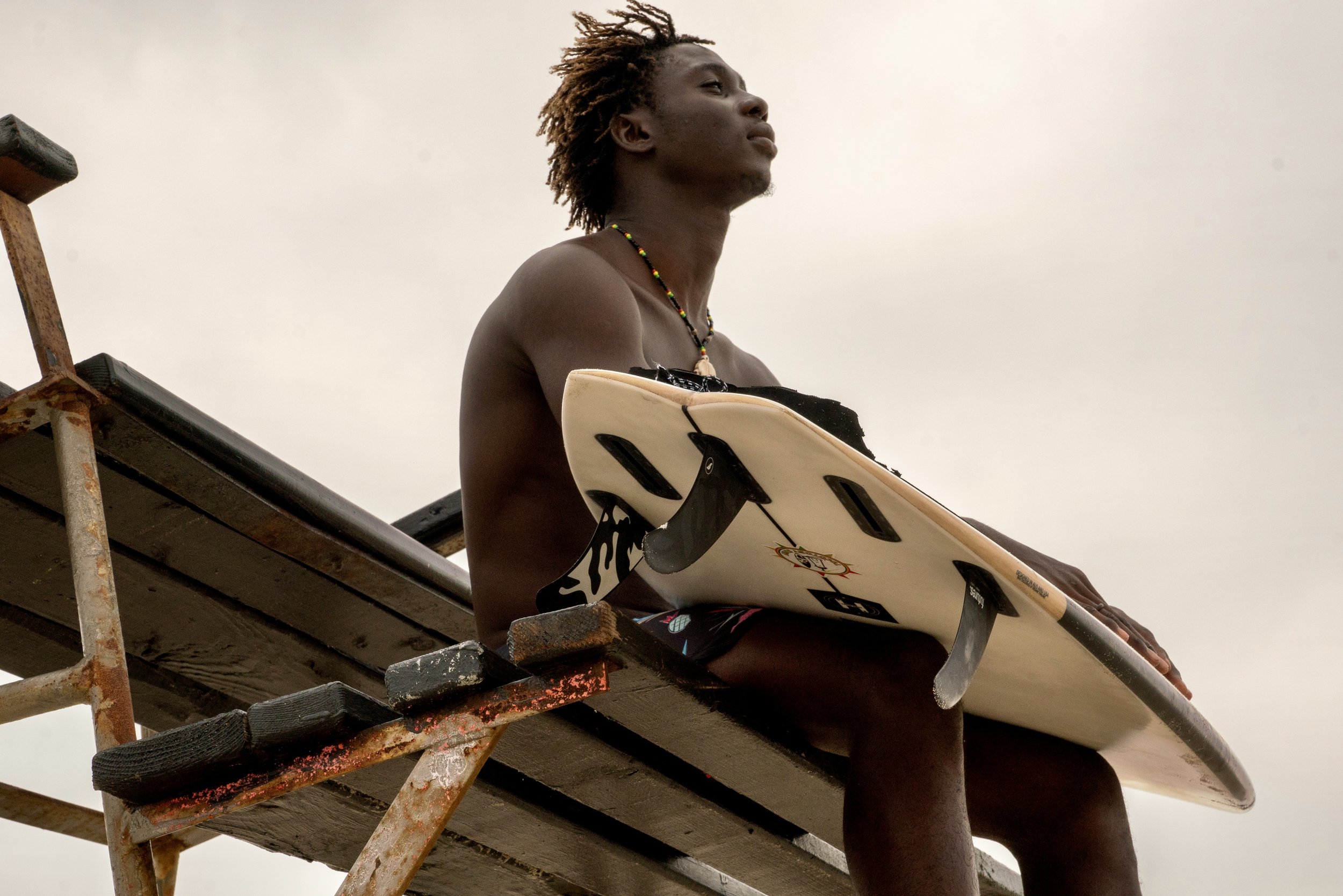
Javii looking out at New York City waves in Rockaway Beach.
On a hot and sunny July morning, I ran into a friend on the beach as we both stopped and watched a surfer neither of us recognized. I’ve photographed surfers in Rockaway for years, and I can spot them by their style, their tell (everybody has a tell), and/or their board from a pretty far distance. I’d been shooting from my balcony as I did most mornings, but headed outside, wanting to get a closer shot of the unknown surfer. His style confident and strong, he caught airs one after the other, charging in a way that made the waves appear bigger than they were. East Coast surfers are gifted in that. I knew at once he traveled to surf, and I wanted to know more about him. After riding a wave to shore, he walked out and noticed me. I mean, it’s hard not to notice someone pointing a 400mm zoom lens at you. He had the most infectious smile, and I knew my camera would be drawn to him if we did a shoot together. His name was Javaun Brown, Javii for short, and he was from Jamaica. He was visiting NYC for the first time and staying with a friend he met on a surf trip to Puerto Rico. We exchanged information and made a date to shoot together.
A few days later, I met up with Javii at Beach 69, where he’d started temporarily working as a surf instructor, making extra money for his travels. He’d become savvy over the years at stretching his money and using his surf instructor skills to make money wherever he ended up. He was helping a surf student warm up before a lesson with David, the owner of Sierra Surf School. I watched Javii interact with the student, and how he was confident but not cocky. His movements slow and methodical, he had her mimic the moves, and she relaxed immediately. Afterwards, Javii and I walked downtown to find a less crowded spot. Our conversation was slow and thoughtful. We started with surfing but quickly eased into talking about everything: family, travel, and mental health. He was so easy to talk to, and I let my guard down at once. We bonded over similar struggles and our devotion to nature and the ocean.
Is this your first time in New York City?
JB: Yes this is my first time in New York City, my first time in the states, and my first time being away from home.
What do you think of it so far? Is it everything you thought it would be or different?
JB: I think New York City is a global center for many things, including culture, technology, finance, and other entertainment. Therefore there are lots of opportunities here that I haven't been exposed to. It is definitely different from what I thought it would be, because I’ve never really been to or seen a big city before. Almost everything is new to me here, which is just a great experience for me and my life’s journey. Definitely lots of opportunities where I could make my way and find the rhythm of things I want to do.
When did you first start surfing?
JB: I started surfing when I was 5 years old on a bodyboard. It was the best feeling I ever had at that age and point in time. Since then I’ve never stopped doing it, despite the challenges faced in my daily life. Surfing has changed my whole life and makes me the person I am today.

How long have you been a surf instructor? What do you love about teaching someone to surf?
JB: I have been a surfing instructor for 9 years. I was certified 2 years ago, which helped me to go to school for a little bit, because my parents were financially unstable. I love teaching because I like to see people happy surfing the waves of their life and enjoying the ocean vibes. The ocean is a healing place. Making a difference—students may be going through difficult times in their lives, and surfing could help turn things around for them. Seeing students progress—it can be enjoyable to watch students learn the basics of surfing, like standing up on their first wave, as well as more advanced techniques. Sharing a passion—some people feel natural at coaching and enjoy sharing their love of surfing with others.
Localsurfer.javii offers different experiences in the water: surfing, boat tours, water falls. Tell us more about your business and what clients can expect if they hire you?
JB: So my small business is what I live from. Sometimes it is not consistent enough, because not everyday we get tourists. Clients can expect a safe space, great local vibes, peaceful atmosphere, and all around positive vibes. I give undivided attention during each tour, and each tour is customized based on what the individual wants to do.

Have you always been an ocean lover? What inspired that love and appreciation?
JB: Yes, I have always been an ocean lover, because I grew up around the ocean. I’ve spent all my life in and around the ocean, surfing, snorkeling, fishing, and sailing a boat. I live by the ocean. I think it is an ultimate resource that shouldn’t be taken for granted. It is just basically my life; everything I do revolves around the ocean.
You’re a world traveler. Has travel always been a part of your life?
JB: Yes, it has always been part of my life to travel and see different cultures, places and things, different perspectives of the world and its history and all the diversity of the world that is so unique.
Where have you traveled and surfed that you loved the most and would go back again?
JB: I love Puerto Rico, El Salvador, and Panama. I would definitely go back to any one of these countries again. Also I’m open to new opportunities to surf other countries.

You represented Jamaica at the ISA world surfing games in Puerto Rico back in March. What was that experience like?
JB: I loved it. It was a great experience, and I’m so grateful to have had it. I got to see most of the top tier surfers in the world that surf in the World Surf League and also surf with them. I normally watch on television; it was so inspiring to see them live in action.
One of my favorite things about living in Rockaway is the community. It looks like you have a really supportive community at home too. What is that community like? What does community mean to you?
JB: My community is a very small village that is known for its clear waters, surfer-friendly waves and the shore's soft, powder-white sands. But even more prominently, Boston Beach is renowned for its delicious Jamaican eats. This beach claims to be the birthplace of jerk seasoning. So come hungry and ready to taste-test at nearby eateries, which feature jerk foods. The community means a lot to me. Working and acting together, building friendships along with being united is vital to how we operate in the world. It is always home for me. 80% of the people in the community know me as that great surfer. I would love to get more surf equipment there and put my community on the map so people know that there’s great surfing in my community.

I see that you’re always wearing this unique and beautiful elephant necklace. Is there special meaning behind it?
JB: I have been wearing this necklace since I was 17 years old. It means protection, stability, resilience, wisdom, and good luck in all fortunes.
The heart of this journal is experiences in the wild. I live in New York City, but living by the beach is much different than living in the city. What does wild mean to you? How have you made sure to keep wildness at the heart of your daily living?
JB: Wild for me means living and growing in natural environments. It means you only get the day once so you might as well just live and enjoy it. Take everything for what it is, accept it and live the reality.

When we shot together on the beach, we really connected over our shared mental health struggles. You told me about this magical place back home that helps you calm your mind and find peace when you're feeling down. Tell me more about that body of water and how it comforts you.
JB: This body of water is called the Blue Lagoon. It is located in Port Antonio and is a wildly popular travel destination for families and honeymooners. Glistening, turquoise blue water surrounded by lush greenery. The blue is a vision of beauty. The water seems to have a bit of magic to it, as the color changes throughout the day, depending upon the way the sun shines upon the surface. The vibes there are incomparable; warm sea water meets the mountain spring water. This water comforts me, because it heals my soul and always puts my mind at ease. I have an innate connection with this natural environment.
You talk about meditation helping you be at ease with your thoughts. I've always found it challenging to meditate. Any advice for how to do it and how to incorporate it into daily life?
JB: Find a comfortable place, Bring mindfulness into meditation, Start your meditation. The challenge of focusing the mind. Get the hang of meditation and Bring your meditation to a close. In meditating I acknowledge wandering thoughts so I can let them go and return to focus. You notice your surroundings and the feelings within your body. Here are some ways to incorporate meditation in daily life: Start small, find a quiet place, focus on your breathing, use guided meditation, and be consistent in whatever you are doing. Connect it to an existing habit.
Looks like you've continued your travels after NYC. Can you share some of the highlights?
JB: Yes, I have continued my travels after NYC. Some highlights: went back to Ohio to get the rest of my luggage together. Then headed back to my home land, where I only spent 2 weeks before taking off to Trestles in San Clemente, California to watch the WSL Final 5 event and to meet and greet some more legends in the surfing industry. I made some great memories, exploring and connecting with surfers, other people and companies, and picking up surfboard sponsorship from Lost Surfboard Mayhem by Matt Biolos. After that I entered a competition in Huntington Beach by A Great Day To Be Stoked, where I came in second place which was a big motivation for me.
After that I went to El Salvador to chase waves, because it was flat ocean in Jamaica. It was great to surf and catch up with some old friends. Afterwards, I went to Puerto Rico to compete in the Corona pro circuit where I had a not so good experience, but I had a great time. Now I’m back in Jamaica.
What’s next for you? Any other exciting travel or competitions?
JB: Honestly not sure what is next but I’m planning on going to Central America for a little bit. Another exciting trip I’d love to take is to set foot in the motherland (Africa). I have local competitions coming up. However, I'm not sure about international competitions. Life doesn’t always go how you plan. So I’m just following my heart and intuition.

Javii, what are two or three things you know for sure in this life?
JB: I know for sure I want to put Jamaican surfing on the map, competitive wise and friendly surf wise, letting people know there’s surfing in Jamaica. I know for sure I want to help and definitely build up my community. Last but not least, definitely build more on myself and my surfing career.
You can follow along Javii’s journey on Instagram @localsurfer.javii


Five Toe Joe
Surfing again has reconnected me to a part of myself I thought was lost. Just sitting out there on the board, legs dangling, hand pushing through the surf, listening to the sounds of the ocean I felt whole again.

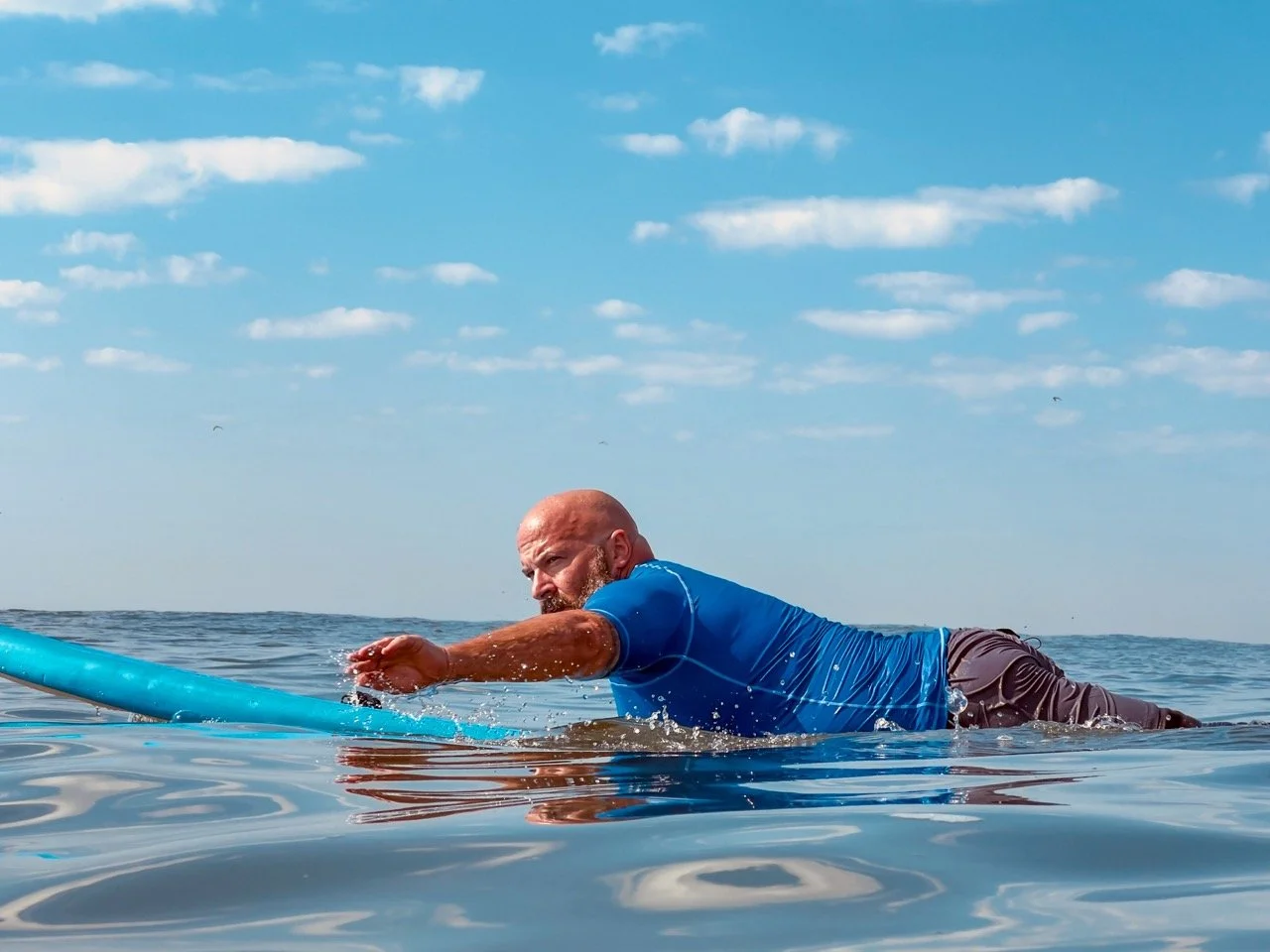
Joseph “fivetoejoe” Glascott surfing in July at the AmpSurf event in Rockaway Beach, New York City
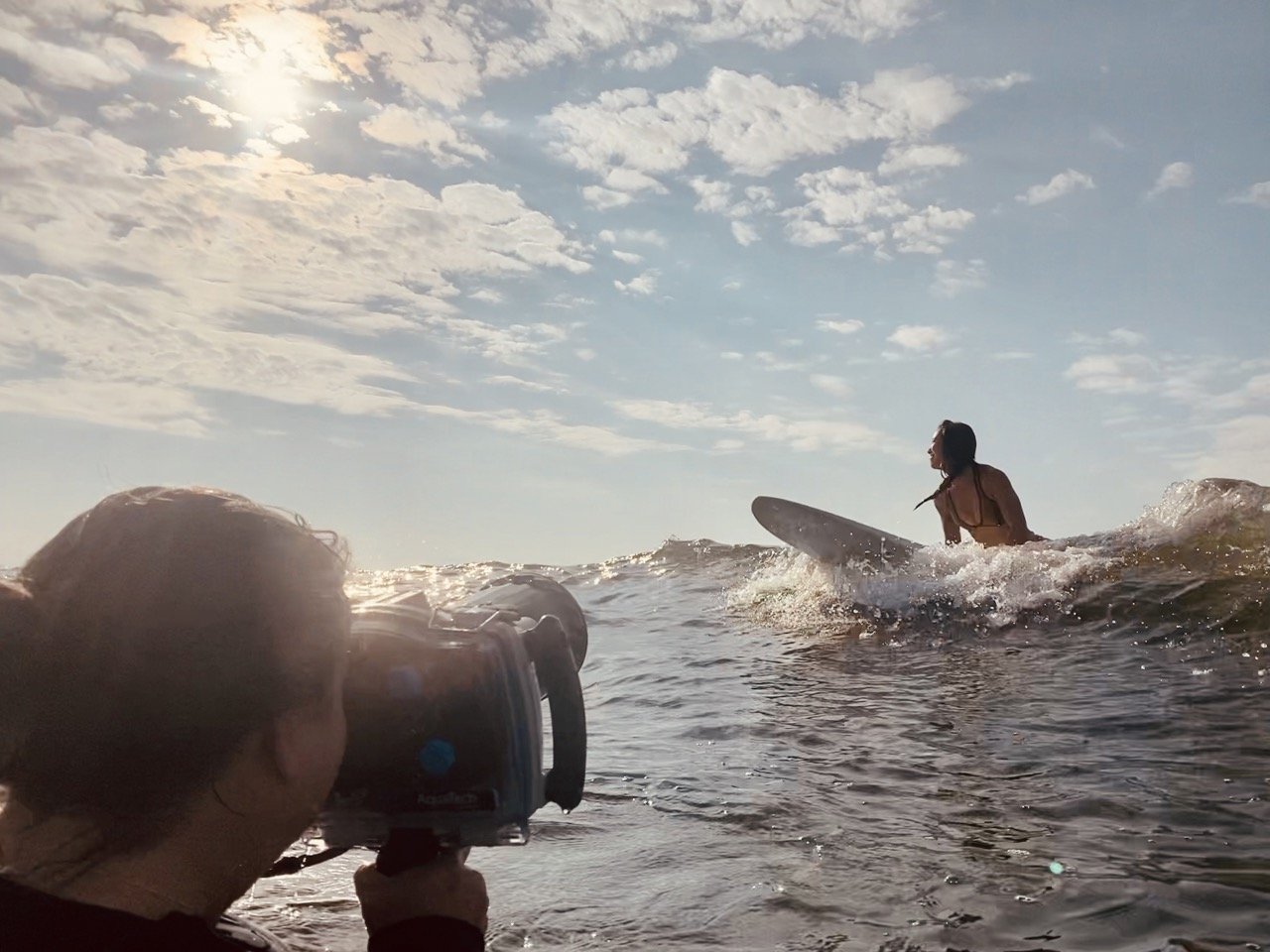
It’s a sunny Saturday morning in July. The water is warm, right around 70 degrees, and the sweet sound of yews echo up and down the beach. I’m swimming around surfers and AmpSurf volunteers, working hard to capture the pure joy of the moment. Bill’s out in the water too, shooting video. I turn my camera towards the jetty, playing with the uptown light, and at once I notice a surfer sitting in the lineup. We quickly start this dance: he gets in position, I get into position. It feels really familiar, and I wonder who he is. I’m guessing maybe he’s a volunteer who decided to catch a quick wave or two before things really got going. I shoot him turning the board around and then his arms paddling as drops of the ocean fall from his fingertips. His face is serious and focused. He spots his wave, paddling into it as the volunteers nearby make room, and we all watch and yell in unison. As I photograph him pop up close to shore, I realize at once he’s not a volunteer; he’s one of the participants. Like all the surfers I know and love, he gets right back on the board, and paddles back out. I shoot him as he glides through the water, the two of us making eye contact as we head farther out. Some of the volunteers circle around him, in awe of how well he surfs. I hear pieces of his story as he talks about his relationship with surfing—I’m certain I hear him say it’s been twenty years since he’s been back in the lineup.
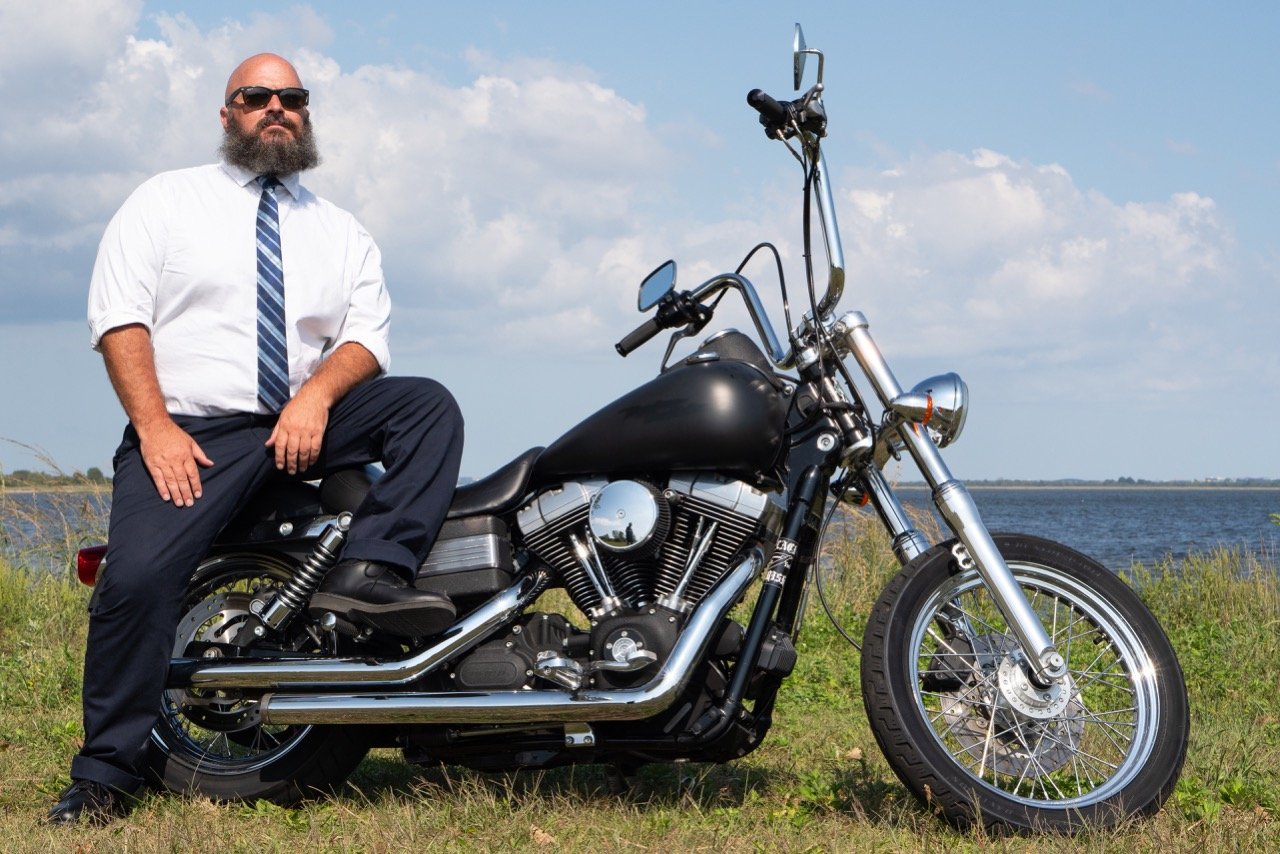
A few weeks later, Joseph Glascott, driving his beloved Harley, meets up with Bill and me at Floyd Bennet Field. It’s surreal seeing the bike in person now that I know more of the story and how his motorcycle plays a key role. Joseph wears a white button down shirt and dark dress pants, a navy-blue patterned tie and pocket square tucked away in his backpack. It’s always weird to see a surfer in “street clothes.” I’ve photographed him before, and we’ve been talking often. It’s interesting doing photo shoots with friends, and he’s definitely my friend now. The three of us can’t stop laughing as we move around the location to unique spots I’ve scouted just for this day. At once, I see that this isn’t his first photoshoot. He’s mastered poses, knowing exactly how to position himself, just like in the water. I give little direction. He smiles and tells me he has a bit of experience with modeling/acting; he was in a Hot Wheels commercial back in the day. Bill is beyond excited! Later back home as we’re talking about what a unique shoot it was and how much fun we had, Joseph sends me a text. It’s the commercial. As we watch it several times with ear to ear grins, I think about him as a little kid, growing up, as he told me, surrounded by positivity, a lesson handed down from his Dad and a quality you notice the minute you talk to him. Like every great teacher, Joseph’s taken that inherited positivity, applied it to his own life, and freely paid it forward to the next generation and all of us lucky enough to call him friend.
When and where did you first start surfing?
JG: I started surfing, boogie boarding actually, when I was about 14/15 years old down at the West End 2 jetty. Started learning how to catch waves and the general rules of the line-up. Back then WE2 was pretty territorial so you had to learn fast. The next summer I borrowed my cousin's board, a 6’2 trifin thruster, that was hanging in my grandmother's garage, and paddled out for the first time. After that day I was hooked. It was tough learning at WE2 since I'm goofy foot and soon made Gilgo my home surf spot. Eventually, I moved up to an 8ft locally shaped board from a shop called Phoenix and often borrowed friends longboards down where we were at.
Has water always been important in your life?
JG: The ocean became a shaping force in my young life. It provided me with many of the lessons young men need to learn at that age, like patience, humility, and the love of the natural world. It also taught me how to challenge myself, not allow fear to hold me back. The more time I spent in the water the more I wanted to learn about it and eventually got involved with ocean and environmental issues on Long Island.

Surfing again has reconnected me to a part of myself I thought was lost. - Joseph
When did you learn about Amp Surf?
JG: I learned about AMPSURF from my girlfriend Kailey. She had listened to me talk about the good ol’ days of surfing back before I lost the leg and how much it meant to me and my life. She started asking why I didn’t surf anymore, and I listed all the reasons I gave away my board and why it was an impossibility in my current condition. This made her laugh because of the fact that riding motorcycles again was never in question, but for some reason surfing again seemed like an impossible task. So apparently there is this thing called Google, and she typed in amputee surfing, and Ampsurf was the first result to pop up. She wanted to surprise me by signing me up as a birthday gift but wasn’t sure if I would be into it. Needless to say, I was blown away by the thoughtfulness of the gift and that she believed I could do this even when I didn’t.

The loss of my leg and my new status as an Asymmetrical American™ 🤣 was brutal at first. - Joseph
Joseph, how did you lose your leg?
JG: I lost my leg in a hit-and-run motorcycle accident in Oct of 2008. While riding home from a friend's house, someone ran a stop sign, hit me off the bike and left me for dead in the street. They didn’t amputate the leg that night like they should have since my vascular sys in the leg was destroyed. I spent the next two months in the hospital. After eight or nine surgeries, the doctors said all they could do was keep cutting back the infected areas, and that's when they told me I had to make the decision to either keep going or to amputate the leg below the knee. It was the most difficult decision I had ever had to make, but understanding my situation could get worse if I didn’t, I made the choice to have them go ahead and remove the leg.
How has your life changed because of that loss?
JG: The loss of my leg and my new status as an Asymmetrical American™ 🤣 was brutal at first. The only thing that kept me going and in positive spirits was the love and support from my friends and family. That may seem cliche but it is the absolute truth. If it wasn’t for them, I wouldn't be here today. Recovery was steady but slow. I returned to work in January of 2009, even before I had my prosthetic. I am a school Librarian and missed my students. Getting back working with them helped a lot too. Once I healed up I started working with a great company called International Prosthetics and Orthotics. After a year or so with the help of a cane, an Irish Blackthorn to be specific, life started to get back to normal, or at least the new normal. I had to learn how to do many of the simple things of daily life all over again with consideration of the leg and balance and how to deal with the pain once I weaned myself off of the Dilaudid. One thing that didn't change was my love of motorcycles. I was up riding again in the fall of 2009. Yet, for some reason, the idea of surfing again seemed an impossibility until recently when someone I have come to care for very much signed me up for the AmpSurf event.
Wow, so you got right back on your motorcycle without hesitation?
JG: There was never a doubt in my mind that I was going to ride again. It took me about about a year or so to be healed up and strong enough to ride, but my good friend Irish Rob told me whenever I was ready I could take out one of his bikes. I spent a lot of time during my recovery at Rob’s house. So one day we were just hanging out, and the feeling, the need hit me. I asked Rob where the keys to Red were, red being his red ‘05 Sportser, and without hesitation he told me the keys were by the back door and that the garage was open. He didn’t make a big deal of it or even follow me out. He just let me have that moment to myself. I only rode up and down and around the block a few times that first time out, but in those few minutes I felt like I was whole again.
What was that like going back to work? How did your students and coworkers react?
JG: Going back to work was challenging. I didn’t have my prosthetic yet and had to get around on my crutches and it was obvious that something was “missing.” At the time I was working at the Jr High School and the kids, like most kids, asked all the odd and awkward questions that only kids will ask and it was great. They were like, “sucks you lost your leg. Can I see it?” They had no pity, just empathy and curiosity.

Tell me about the idea of using the nickname Five Toe Joe.
JG: The nickname FiveToeJoe was given to me by my long-time friend and riding partner “Irish Rob.” Much of my recovery was spent at Rob's house in the garage working on motorcycles, drinking beer, and talking shit. Rob likes to break balls and bust chops and on one particular day we were carrying on about something ridiculous when he said “Hey five toe, let’s go.” Embracing the name helped turn something tragic into something of an identity to be proud of. Being disabled wasn’t something I was going to be ashamed of. So I embraced it head on, and FiveToeJoe was born.
Did you decide right away you were going to participate in the AmpSurf event?
JG: As soon as Kailey told me about it I was in. I did have some questions about whether or not someone with a below-the-knee prosthetic could participate. After a quick email to Dana, the founder of AmpSurf, I was assured that the coaches and volunteers would absolutely be able to accommodate my handicap and get me surfing again.

I never thought I would be able to pop-up and surf again.
For the first time in twenty years, you were back in the line up. That was such a heavy statement to hear you say. Can you describe what that was like? Physically? Emotionally?
JG: Physically, it was a serious challenge, but the joy and adrenaline of being out there again kept me energized and paddling out for just one more wave every time I rode one in. I’ve found it difficult to work out over the years without getting hurt and wanted to get back into the water just for the workout. I never thought I would be able to pop-up and surf again. Emotionally, it is still tough to describe. I love being in the ocean. About a year ago I had my prosthetists at IPO make me a water leg so that I could walk into the ocean again. The idea of taking my leg off and floundering into the water was something I was embarrassed about. I had finally come to the point where I wanted to get more out of life and start getting back to doing things that brought joy to my life. On my 45th birthday, I was at my house in Maine and walked into the ocean for the first time since 2008. It was an emotionally overwhelming experience. Being in the ocean and connecting to something so much larger than oneself was a power I had not felt in a long time. Still, the idea of surfing was something I couldn't even imagine. It took the faith of someone I love to convince me I could do it. And because of that faith and belief in myself, I had one of the best days of my life with AMPSURF and plan to continue to keep getting out there.
How has surfing again affected you?
JG: Surfing again has reconnected me to a part of myself I thought was lost. Just sitting out there on the board, legs dangling, hand pushing through the surf, listening to the sounds of the ocean, I felt whole again. Also, rising to the challenge and accomplishing something I truly thought was impossible has motivated me to get out there more and challenge myself with other things I thought were out of reach.
Do you plan on surfing more?
JG: I absolutely plan on surfing more. I already started saving for a new board and hope to be back in the water next spring if not sooner.
If someone is considering participating in an event with an organization like Amp Surf, what kind of advice or words of encouragement would you share with them? What can they expect? And how do they push through the fear?
JG: AmpSurf is an incredible organization. From my early questions, to getting in the water, I felt supported the whole time. The event was well organized and every person involved was kind, friendly, and had so much genuine encouragement. I felt like there was no way I could fail. I would encourage anyone, regardless of their disability, to participate in an AmpSurf event. I felt safe and supported while on the beach receiving instructions to being in the water with the coaches and all of the amazing volunteers. So much so that I hope to be able to volunteer in any way I can at some of next year's events.


The idea behind The Wild Journal is living a life that’s connected to nature, the outdoors, and water, being totally aware of its importance. Wild means something different to everyone. What does wild mean to you?
JG: To me wild means freedom. Free to connect with who or whatever you love. Free to express yourself, and free to create the world around you. But something that is wild is also something to be respected, honored, and revered. The ocean and the world around us should be respected for its unique beauty and power. There is nothing so humbling as getting lost in the woods or being pounded by a wave to make you feel humble to the majesty that is Mother Nature.
You recently celebrated your birthday with a trip to Paris during the Olympics. You look happy and like you fit right in to the Parisian vibe. Is that a trip you’ve always thought about?
JG: I’m my wildest imaginings I would never have believed that I would get to celebrate my birthday in Paris, France with a woman for whom I have come to love so dearly. It was not a trip I had ever planned on taking, but it was the perfect birthday and trip I will not soon forget.
Do you celebrate birthdays differently since your accident?
JG: Not really. Birthdays have always been low key events for me. As I said earlier, with the love and support of my friends and family birthdays and holidays were always joyous events. Being asymmetrical didn’t change that.

Joseph, what are two or three things you know for sure?
JG: 1. Shit Happens 2. Compassion is the Way 3. With love, life is simple, anything is possible


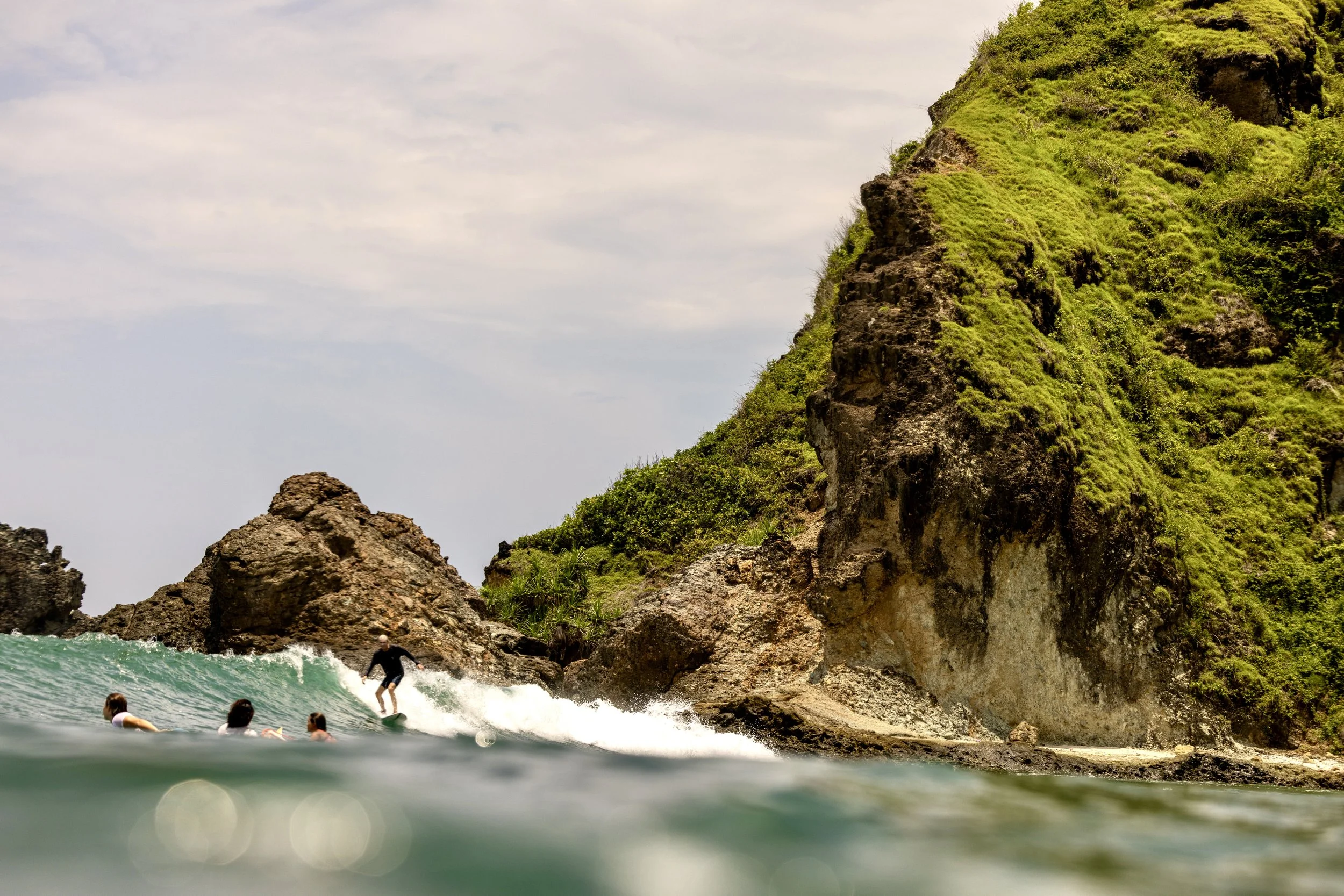
A Beautiful Purpose
To build the conditions for people to rest their minds and bodies and to enjoy something as wonderful as surfing and yoga, it’s a beautiful purpose.

Jose riding waves at Kuta Beach
Jose’, Thank you so much for doing this interview with me. We’ve only known each other for a few months, but I can honestly say it feels like I’ve known you my whole life. I felt an instant connection to you, and Bill did too. I know a lot of people must feel the same when they meet you. You simply radiate as a person. I believe we will see each other again soon. Maybe in Lombok, maybe somewhere else, but definitely it’s our destiny to reconnect in the near future, and I look forward to that day.
My good friend, thank you for choosing me to help you with this task. Please excuse me for taking a bit of extra time to complete it but some questions I wanted to think deeply before answering them. I also felt a warm and kind connection with you and Bill. I admire couples that have endured time and life challenges and you can still see crystal clear how they love each other, like you two. An inspiring couple for me. I'm also sure we will meet again, don´t know where, but we will. Until then, we will keep in touch thanks to the tools that technology has given to us. Take care of yourself! A big hug for both of you, José
Travel lies at the heart of our connection in Indonesia. What role has travel played throughout your life?
JRG: To travel it has been a new discovery. I have traveled a bit in my life but always were “easy trips”, like going to Disney or close to Chile. It was just in 2020 when I went to an unusual destination such as San Juan del Sur, Nicaragua, and immediately I felt that something changed or woke up in me. In this part of my life, travel has helped me to trust in myself, to broaden my perspective and because of this, to value even more the differences between people. Curiously, and that's another reason for me to believe that I'm at the right place, the Indonesian motto is “Bhinneka Tunggal Ika” which can be translated to “unity in diversity”.

Just a few weeks ago you celebrated your one year anniversary with Xanadu. Congratulations! I would’ve guessed you’d been there much longer. You seem as if you’re one with the property. Can you tell the story about how you came to Xanadu and eventually ended up starting your life and career over in Lombok?
JRG: I think we all are quite connected with the vision. Probably Xanadu is a common dream of everyone who works here. I just happen to be a more visible face for the guests. But I'm just another piece in a network of a hard-working committed team.
After 10 years of working in politics and teaching at my law school I decided to do a long solo trip. Wanted to know historical places and to learn how to surf properly. So I went to Europe for three months and then I came to Indonesia for three months, mainly in Uluwatu by then. But I'd heard about this magical island where the surf is great. So I was a guest at Xanadu Village in August 2022. I could see that the weekly package was well organized and structured, made for improving your surfing. I got to know Ola, one of the owners, because we have a friend in common. And I could recognize an admirable strong woman with the will to build an honest business, with purpose and a compass. Out of a joke we started thinking on the idea of me being the host, since she wanted to have someone thinking about the guests, whilst the surf and staff areas were covered by two great persons: Kayan and Ton.

Do you ever miss that other life? The suits? The formality? Any of it? How were you able to let go of that life, what you knew, to provide space and fearlessness to start a new life?
JRG: I´ll always miss serving my country and working with people committed to build a better, free and fair society. Politics were invented to improve people's lives. Here at Xanadu my role, in a whole different scale, kind of looks like that. My goal here is to improve our guests' experience and I'm surrounded by people who honestly care about giving good service. To build the conditions for people to rest their minds and bodies, and to enjoy something as wonderful as surfing and yoga, it's a beautiful purpose.

Do you think of it as beginning again? Or as an extension of your past life?
JRG: It is a whole thing. I couldn´t be doing what I'm doing without that experience. Aren't we all our history as well? We are in the present who we were in our past. And it's up to us how we want to be in the future.
In the US it’s normalized to think a career choice and job defines us. Is that the same way in Chile’? Europe? Asia? Do you see yourself defined by your job? Or is it different for you? What’s your relationship with a career or job?
JRG: There is dignity in working, aiming for excellence. You can see people's ethics in their performance at their jobs. I don´t think your career defines you as I don't believe society tells you what to do or not. It is us, and our thoughts that shape us. We are free as we are responsibles.

You have an ease about you, a light. Everyone staying at Xanadu during the workshop was drawn to you. You always had a smile on your face. Have you been like that your whole life? Or is that something that’s grown out of living your best life?
JRG: Riley, you are too kind with me haha, thanks for these thoughts. Though I have to say that thankfully we were in a very nice group, everyone was happy, bonding, learning. It's a conducive environment to be smiling.
I celebrated my birthday during my stay at Xanadu. You guys surprised me with a cake and everyone sang Happy Birthday. I usually hate being the center of attention, but I must admit, it was pretty darn special to look over at you and all of my workshop buddies smiling and singing. I’m guessing you are a part of many special moments like that with guests. Are there any moments that stand out?
JRG: I think my favorite moments are during the video analysis that Kayan does every week. To see everyone looking carefully at their performance, huge smiles everywhere, cheering when someone was paddling hard and finally got the wave. To see a group of strangers enjoying a shared time is a beautiful thing to see.

Your love for the ocean provides a special connection to your Mom. Could you talk more about that?
JRG: I´d like to say that the ocean is a huge connection for humanity. We all can connect through the sea. The fact that we surf the energy that was released thousands of kilometers away talks about connecting, right? And for me, family and friends are the most beautiful connections ever, made out of love. And the love from a mother is probably one of the most powerful energies ever.
Can you imagine a life without surfing now that it’s become an integrated part of you? What does surfing give you every time you paddle out?
JRG: Not at all. Surfing has come to stay in my life, hopefully. I don't want to live anywhere if I cannot surf there. I would say it gives me fun through challenge.

I remember Kayan showing me a photo of a drawing you did to teach yourself how to become a better surfer. It was so technical and unique, and I couldn’t stop looking at it. How exactly did you learn? What were the details of that drawing? I’m hoping we’ll have a copy of it to include in this piece. It was really phenomenal, and I loved hearing Kayan tell the story.
JRG: There are no secrets here. Just like everything you want to learn: studying, putting your heart on it and practicing. Discipline and time. And of course, a lot of luck on my end, since I ended up at a surf & yoga hotel, and getting to know an amazing and generous surfer as Kayan.
The drawing is from one of my favorites surfers: Laure Mayer. She is just outstanding and so graceful all the time (not only when she´s surfing). So to understand what my body needs to do to do a drop knee, I took a screenshot, brightened up the screen, put a paper on top of it and drew it.

You and I nerded out talking about Coleridge and Kubla Khan. It was wonderful (I don’t get to do that often!), and it was obvious you are passionate about literature, the arts, and philosophy. Who are your favorite writers? Favorite books? Any books you go back to often?
JRG: I'm not as educated as I would like to be but, in terms of poetry, my favorite is Mario Benedetti, from Uruguay (poems like Todavía, Te quiero and Soledades are just magnificent) and Gabriela Mistral from Chile (Nobel prize of literature in 1945). I also like Winston Churchill and his assertive sharp mind and his admirable vocabulary. A book . . . The first to come to my mind is “The Duelists” from Joseph Conrad. Elegant, fun. You can learn so much by reading it.
Can you tell me about Pedro?
JRG: I can tell you he taught me how to be a better human being. His bright smart eyes I will miss and remember through the years until I’ll go to him so we can play together again.

Jose’s beloved dog Pedro
When people ask about my trip to Indonesia, I always talk about the people. Everyone in Lombok and Bali welcomed me and made me feel right at home. They were all lovely and generous. When I saw monkeys in the wild for the first time, I was mesmerized. We were driving back from the beach, and the driver couldn’t believe I’d never seen them. He waved the other Xanadu truck behind us to go around so that he could position our SUV in a spot where I could watch and photograph the monkeys on the road and in the trees. It was a moment I’ll never forget, the monkeys and such thoughtfulness. I was so blown away by the moment, I forgot everything else, including the driver’s name. What stands out for you about Indonesia, and more specifically Lombok? Has it changed, and if so in what way, since your first visit?
JRG: His name is Rindan. And he, as people are here in Lombok, is such a kind person. That is one of the things that I like the most about Lombok, the kindness that people usually show you. A genuine friendliness in your day to day life.
Do you feel like you’ve found your wildness in Indonesia or in surfing and being in the water? What does Wild mean to you?
JRG: I like the thought of connection with nature. More than with Indonesia, even though Lombok is an amazing paradise, my connection with nature comes since I was a child and the house where I grew up in was full of different trees, a grapevine, really pretty. And then, when surf appeared, well, then I got to enjoy nature again as if I was a kid.

Do you have any advice you’d share with someone who’s thinking of changing their life, doing something completely different, whether it’s a relationship or a career, or trying something new?
JRG: I wouldn't dare to advise anyone. I just can say that it's been something positive in my life to chase what makes me happy.
What’s a day in the life for you?
JRG: It really depends on the day, but the common aspects of my week are checking on the guests to know how they are living their experience here with us at Xanadu. Therefore I try to be around, answer questions (from where can I go to a special dinner with my partner to how early should I arrive at the airport?).
I try to surf as much as I can, with the proper balance to have enough time to rest sometimes, and to do other things that I care about, like studying something or helping a friend with a wild journal :)
Jose’, What are two or three things you know for sure?
JRG: That life is beautiful and it will end. That it can change drastically any day without warning. That we are all going to die and so, in between, I want to aim for love in my living. Loving myself, my family and friends, my surfing and my job.

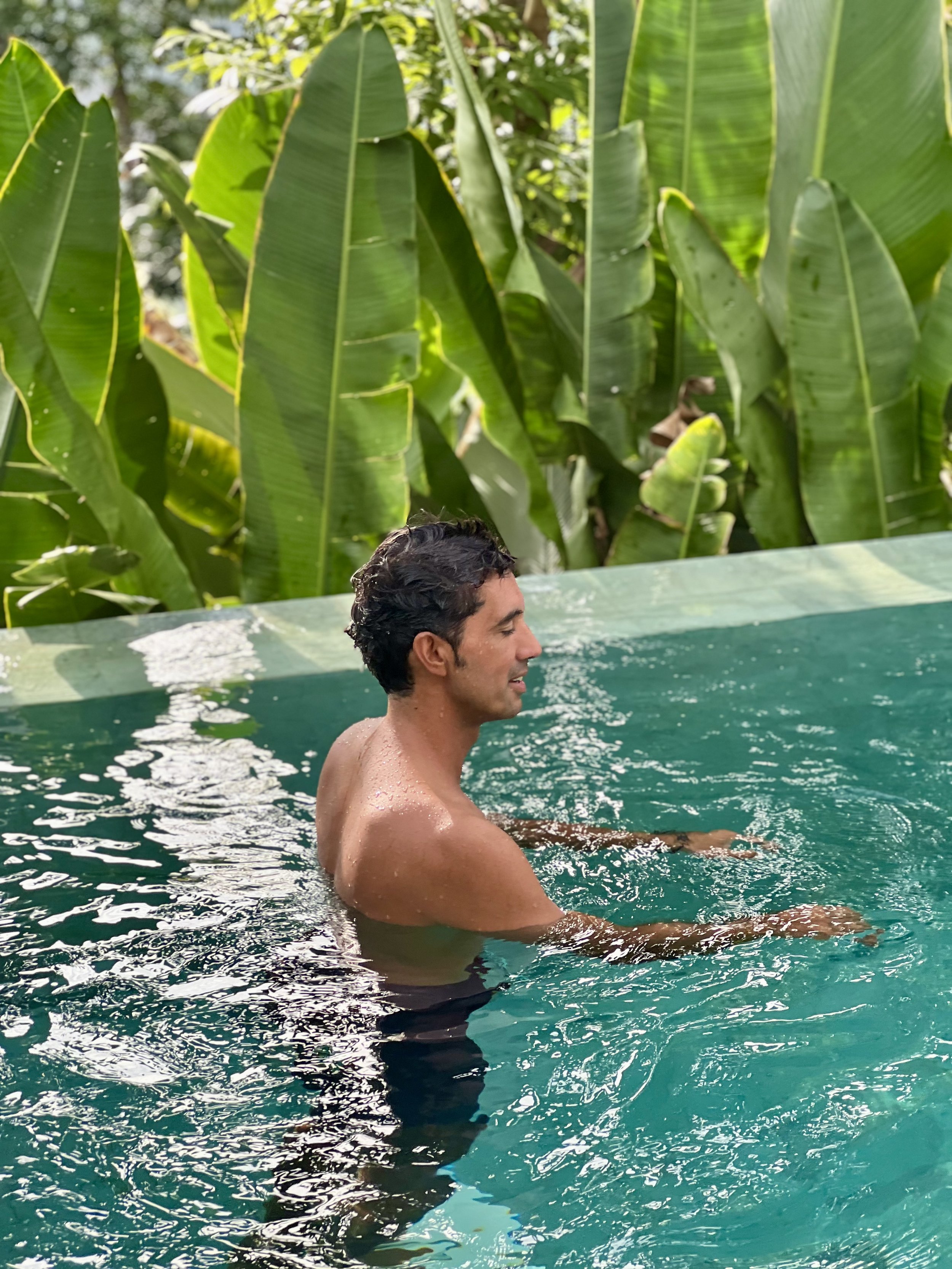


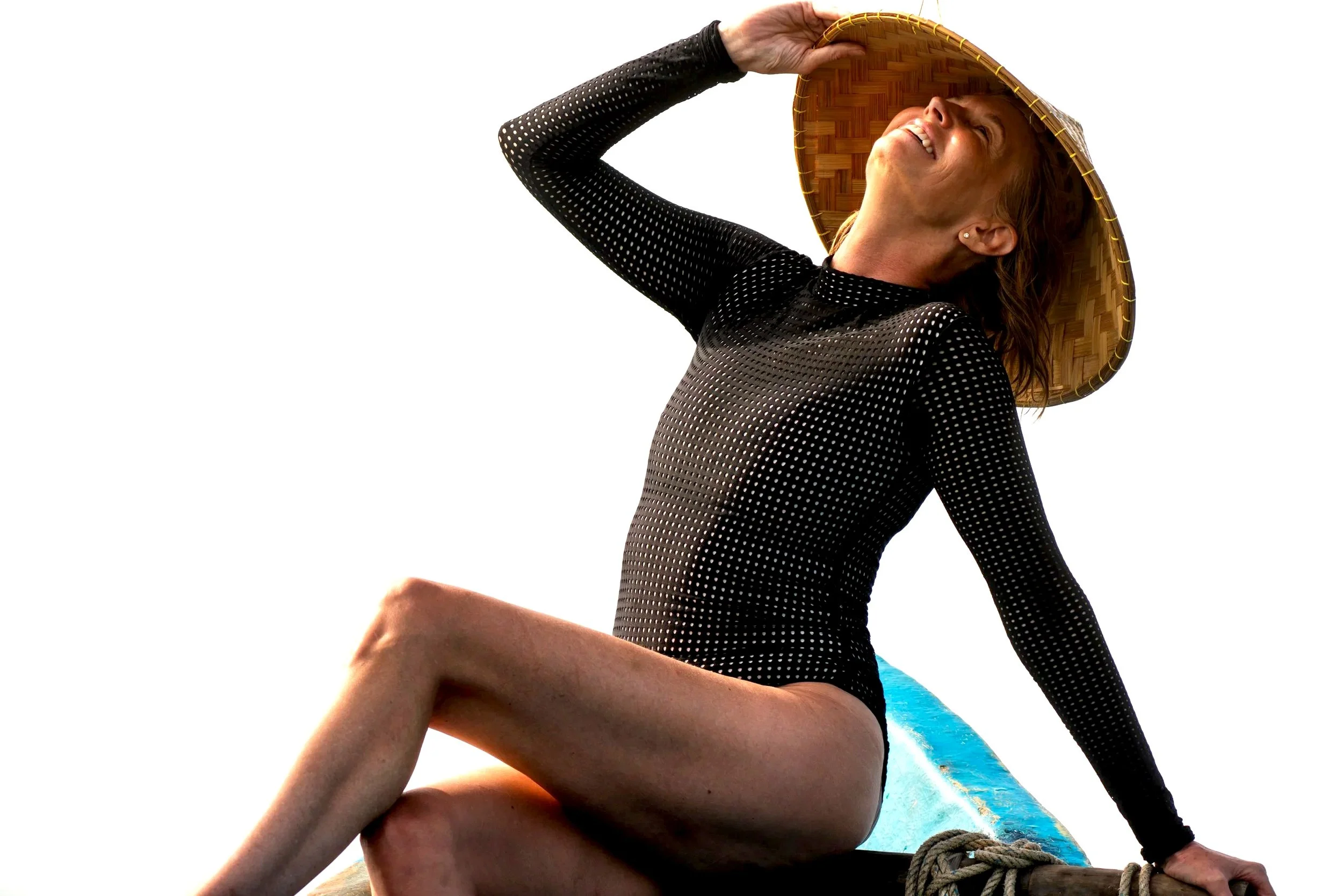
Pointe Break
Getting older means I don’t want to waste time or energy on things that don’t excite me. I fear missing out on all the adventure and beauty life offers more than trying something new.

Kuta Beach by Life of Riley NYC
There’s a trending dialogue surrounding aging, and especially women aging, and how we’re expected to race the clock, searching high and low for all things ageless and anti-aging until we fall head first into some proverbial fountain of youth. For me, the word anti-aging itself feels ridiculous. There is no “cure” to aging. We’re all doing it right this very second. I try living life these days, in my 50s, surrounded by joy rather than fear. A great example of that is my recent surf photography workshop trip to Indonesia for my 56th birthday. I assumed I’d be the oldest person there, and I was cool with that. How crazy that not one but two 56-year-old women flew to the other side of the world, slipped into bathing suits, gripped a couple of cameras, and then jumped off a boat in the middle of the Indian Ocean, and together discovered the fountain of youth.
Rachel, you and I met in Indonesia at a surf photography workshop back in early March. I honestly hesitated about going, right up until the moment I got off the plane in Lombok. I assumed I’d be the oldest person in the group, and although I’m quite comfortable with my age, the whole thing felt unnerving. But I made room for a lot of vulnerability with this adventure, and then there you were, and we were two fifty-six year old women traveling to Indonesia to photograph surfers in the Indian Ocean. Who would’ve guessed it! Tell me how you found the workshop, decided to do it, and your thoughts around age and expectations of the experience.
RW: I know how you feel! I was also unsure about traveling to the other side of the world to subject myself to surviving in waves at a surf line-up! I was afraid I might not be able to tread water long enough, duck-dive under the waves successfully, or that a sharp-finned surfboard would run me over. I had recently bought a water housing for my camera, but the technical learning curve for me with the new gear in the ocean was very challenging. So, when I saw on Instagram that Tommy Pierucki and fellow photographer Ana Catarina were offering a surf photography workshop, I jumped at the opportunity, not believing I would become an in-water surf photographer, but trying not to overthink it.
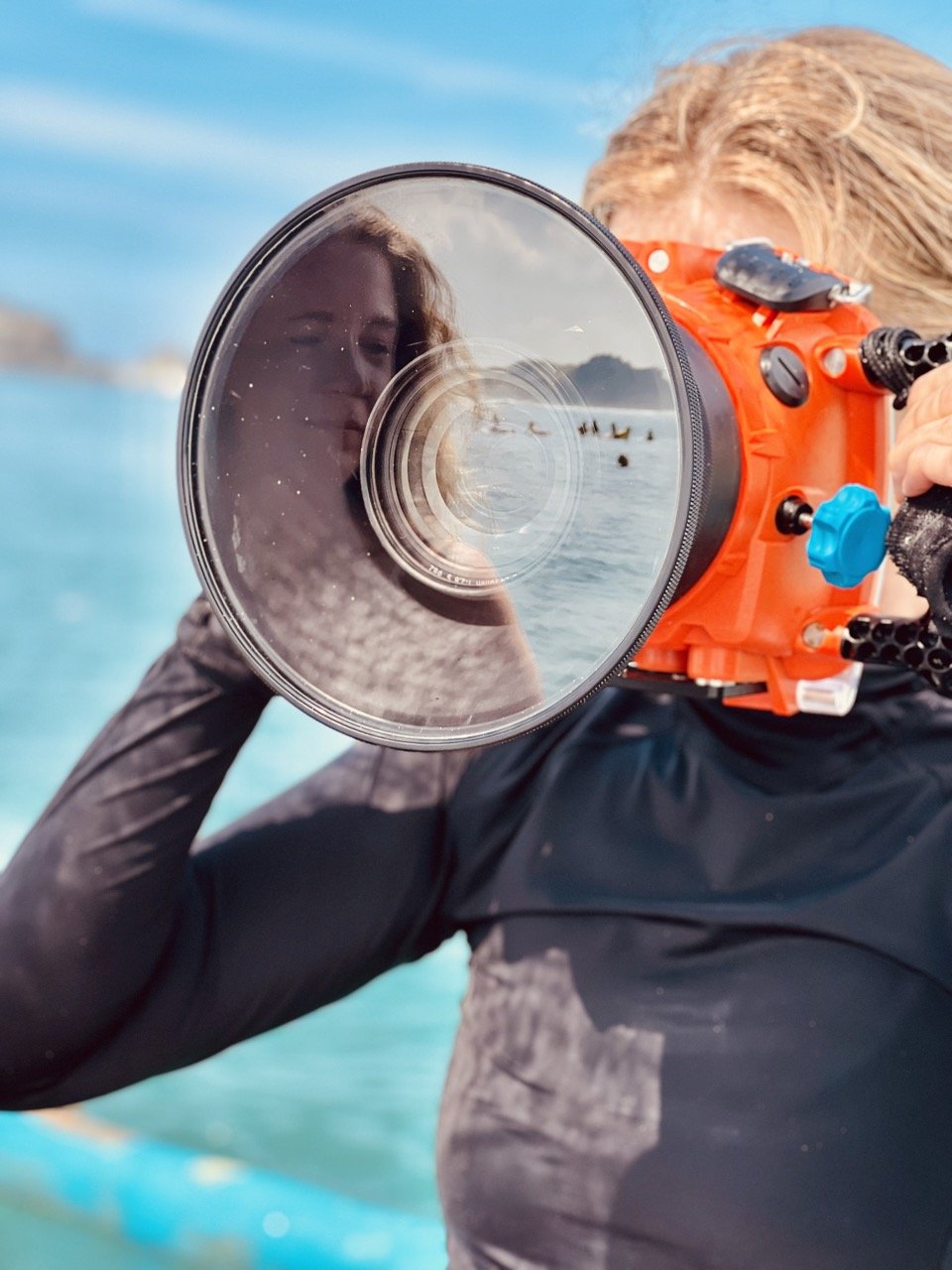
Rachel at Kuta Beach, Lombok, preparing to jump off the boat and head to the surf break. Life of Riley NYC
Once the trip date grew closer, I realized that most of the other class members were much younger than me. At 56 years old, I don't believe age is a factor that keeps me from doing what I want. Even so, I was grateful to have another courageous woman my age by my side for this adventure! After we met, you said to me, “Menopause is my superpower,” and I couldn’t have agreed more. This same attitude helped me to sign up for the class. The beauty of “growing up” (as my friend calls it) is that I am less self-conscious about making mistakes than I was when I was younger. I feel more self-confident, curious about the world, and less afraid to take risks or ask for help. I also have more free time now that my three children are grown. Getting older means I don’t want to waste time or energy on things that don’t excite me. I fear missing out on all the adventure and beauty life offers more than trying something new. That’s why I had to take advantage of this unique opportunity to learn about surf photography from the water.
Have you always had an intimate relationship with the ocean?
RW: No, only in my later adult years did I spend much time in the sea. Even though I grew up on the coast of Northern California, I rarely went in the ocean because it was freezing and full of Great White sharks! In my small town during the 1980s, only the boys seemed to be surfers. I hardly went to the beach and wasn’t even aware of California surf culture back then.
It wasn’t until my mid-20s, when I learned to scuba dive, that I truly put my head underwater. I love diving because it makes me feel like flying through a completely foreign aquatic world, seeing the magical, surreal marine life up close. Later, while living in Los Angeles with young children, we had a sailboat for a few years, and I enjoyed getting out on the ocean to see the dolphins and whales as we sailed to Catalina Island. I only wish I had been a photographer then.
At age 44, I rode a wave for the first time. My friend had arranged a surf lesson for my three children while we were in Hawaii. The lesson was not meant for me, but after much convincing from my kids, I joined them. That day turned out to be the first day of my new life. The free feeling that came with riding a wave, even a little two-foot one, helped to lift me out of the grief I was going through over the end of my 20-year marriage. The fear I felt when the waves tumbled me, held me under, and dragged me forever was tempered by a few brief seconds of the incredible sensation of riding harnessed energy from the sea. That first time on a surfboard gave me a new sense of happiness, confidence, and inner peace that I had never entirely experienced before.
When I returned home, I wondered how I could have lived so close to the sea for so many years and never noticed the surfers riding waves as I drove my daily commute along the coast. I seldom set foot in the Pacific Ocean, only blocks from home. For so long, I had been consumed with city life and my career as a dancer, followed by diapers, carpools, and putting dinner on the table. I never took the time to enjoy all that the ocean had to offer. Now, the sea has been integral to my life ever since that first Hawaiian wave. Even though I consider myself a consummate novice surfer, the beauty of being in or beside the ocean is essential to my well-being as a person and photographer.

Rachel walking in the rain at Xanadu by Life of Riley NYC
You have a background in ballet. Talk about that. How long was your career? And when did you decide to change paths and become a photographer? Did you start your photography journey by shooting ballet?
RW: When my mother turned 40, she started taking ballet classes. She would dance around the kitchen in her pointe shoes and made it look so fun that I began ballet then, too. Even though I started late at 11 years old, I took it very seriously and was fortunate to have excellent training early on. I wanted to be a professional ballerina, but I grew to be 5’ 9”, which was considered too tall for classical ballet. At the last minute, I changed course and went to college instead. There, I studied International Relations and was introduced to modern dance, where I performed in the student dance company. During the summers, I studied dance in New York City. Luckily, my height was not as much of an issue in the world of contemporary ballet.
After college, I moved to Los Angeles and danced in various regional dance companies, ultimately landing at Los Angeles Chamber Ballet, where my classical and modern dance training came to good use. I stopped dancing professionally when I became pregnant with my second child. Having a toddler, a new baby on the way, and dancing was too much for me to handle at once. The dance world is highly exacting, physically and mentally, and I preferred spending time with my growing children.

Impermanence by Rachel Weber
I first picked up a camera when I turned 50. It wasn’t to photograph dancers but to document women surfers in my community. While learning to surf at my home breaks in Los Angeles, I came to admire other middle-aged women surfers I met at the beach. As a novice surfer, I was intrigued by their strength and courage in the waves, and I wanted to learn more about their lives and how surfing fit into them. I had an idea for a book about them and asked my sister, an experienced photojournalist, to photograph these women while I interviewed them. She wasn’t interested, so I naively thought I would just go ahead and photograph them myself. How hard could it be? Well, six years and many photography classes and hours of practice later, I am still learning how difficult it is to take a good photograph! I also still hope to complete that book…
As I delved deeper into the study of photography, I found that I am primarily interested in subjects related to the natural world, including the ocean. I’ve spent countless hours at the beach playing with my camera, watching the sea, and shooting surfers from the shore. Capturing surfers seems to be a perfect union of my love of nature, especially the ocean, and my passion for dance.
I remember how nervous you were those first few days about shooting in the water. At some point you definitely found your sweet spot and relaxed. Later when you shared your photos from the in water shoots, I was blown away by your incredible dreamy images. It looked like you’d been doing it your whole life. When did you decide to merge your relationships with water and photography? And what has that evolution looked like with shooting on land and now in the water too?
RW: Thank you, Riley! And, yes… I was out of my comfort zone in the waves that first day! I remember we were asked to share what we wanted from the workshop, and I said I wanted to stay alive and not get injured. It was funny, but I wasn’t kidding! Having spent more than ten years learning to surf and SUP as a middle-aged woman, I have had my share of injuries and accidents in the water, including a severe injury that took six months until I could walk normally again. I have a lot of respect for the power of the ocean these days, which always seems to remind me that we are not in control.
As a photographer, I’ve been obsessed with observing and trying to capture the ocean for years. I have spent many days paddle boarding through the most amazing giant kelp forests here in California or looking straight down into the sea from the top of the pier, wishing I could capture the ocean’s beauty more directly. It seemed that the natural next step for me was to submerge my camera and myself directly into the sea. I never thought I would be brave enough to get in the waves with the surfers.

Chloe Calmon by Rachel Weber. Shot in Indonesia.
I signed up for this workshop to learn how to stay safe in the water and to know more about the gear and technique. After the first day, I realized that staying on the shoulder of the waves was not giving me the images I wanted. I had to be braver! With the support of our excellent instructors, I finally got into the impact zone. I mostly tried to remain calm in the crashing waves and didn’t know what my photos would be like. It was a massive feat of courage for me since I am not a strong ocean swimmer, but I was pleasantly surprised by my image results. I am unsure how it happened, especially since it felt like I was mostly shooting while submerged. Still, my prior photography experience and our excellent instruction made all the difference. I am now encouraged to get in the ocean alone at my home surf break and practice all I learned.
Striking similarities show in your ballet photography and your surf photography. You have a very unique style. I feel like there’s already this vision in your mind before you even begin shooting. Can you talk more about that and the way you use a slow shutter speed to create another level of movement and depth in your images?
RW: Yes, you are right. I do have an objective in mind before I go out to shoot, and I’ve been working on this vision for years. As a photographer, I am obsessed with seeing, capturing, and pulling apart movement. Whether it’s the motion of the sea, surfers riding waves, or dancers traveling through space, I am fascinated with examining movement as it travels in front of my camera lens. Slowing down the shutter speed offers me a way to play with the passage of time, offering a new perspective into its innate quality of impermanence.
My early training as a dancer taught me how to look and visually comprehend the human body in motion in a manner that has crossed over to my photographic interests and observations. I can’t help but presume that the way my eye sees movement is greatly affected by my many years in the ballet world.
As a photographer, I am intrigued by the active tension in images that capture motion in the inherently static medium of still photography. The camera offers me insight into the progression of time and existence: past, present, and future. Through my lens, the ever-changing conditions of the natural world, the light quality throughout the day, and the varying seasons provide me with seemingly limitless artistic inspiration and joy. I am very fortunate to have found this medium of expression at this point in my life.
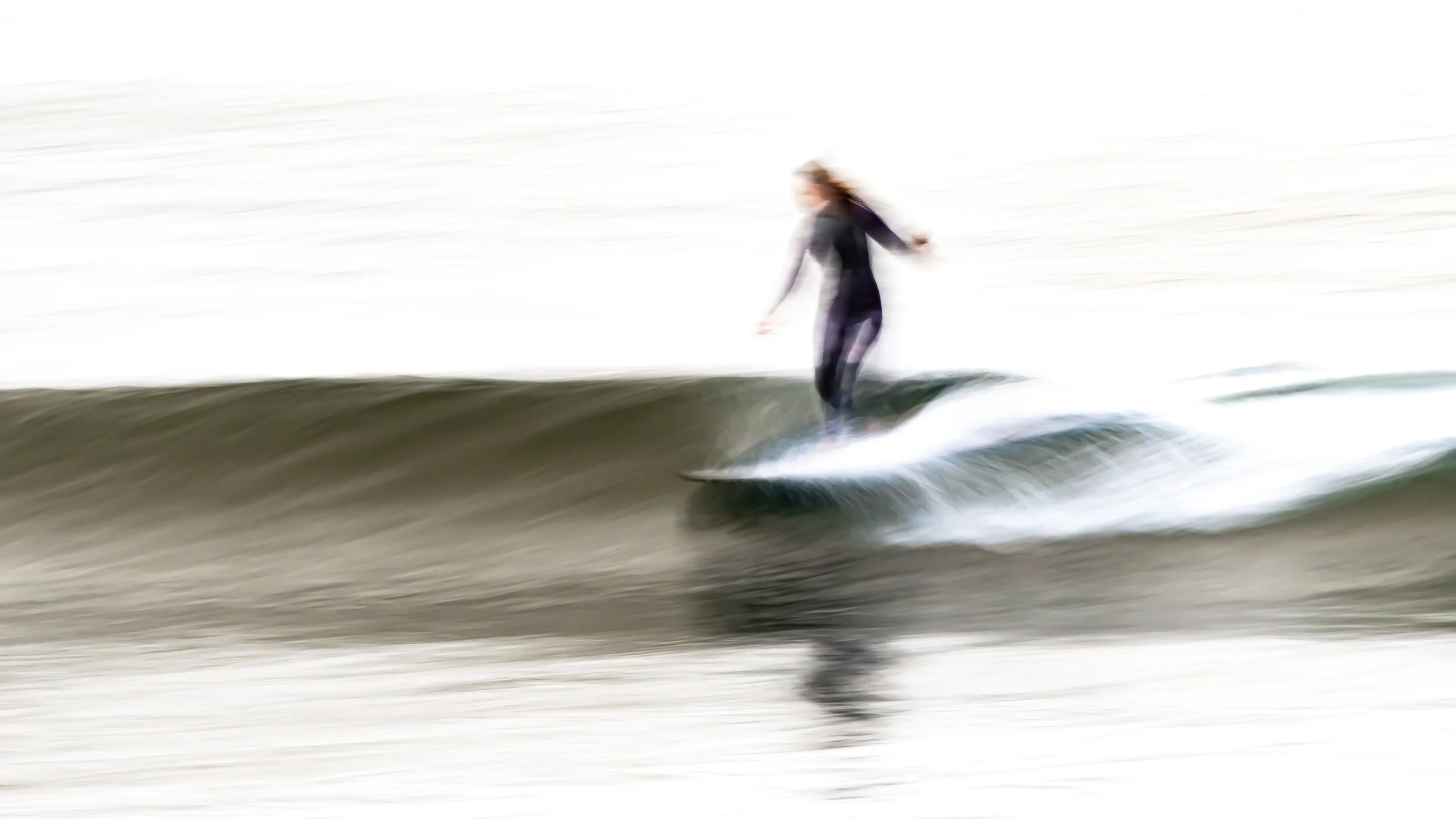
Kassia I by Rachel Weber
We both talked about our daughters on the trip–Mom bonding is the best :). It’s obvious you are close like Jordan and I. How old are your daughters? What are their thoughts on their mom being a surf photographer? And what did they think about the Indo trip?
RW: Yes, I have two daughters, ages 20 and 27, and one son, who is 25. Being a mother, in general, can be challenging, but it brings its unique rewards. I love getting to know them as adults and genuinely value their ideas, creativity, and strength. All my children seem proud of me for pursuing my goals and pushing my boundaries, especially for getting in the waves with my camera in Indonesia. I think they are happy I have something I’m passionate about.
For my daughters, I think it’s important for them to see their mother begin a new path in middle age. My mother was a fantastic role model to me. She followed her passion with an open mind while facing new frontiers, always exploring while staying true to her values. I hope to be a similar example to my children.
Do you travel often? If so, do you choose places based on what and where you want to shoot? Where has been your favorite place you’ve traveled so far?
RW: I love to travel. Now that I don’t have to follow my kids’ school calendar, I am freer than ever to explore the world. I especially love ocean adventures like sailing, diving, paddle boarding, surfing, and now water photography. One of my favorite ways to travel is taking photo classes, and I hope to do more. I’ve been lucky to visit Fiji, Tahiti, Hawaii, and the Caribbean, which have the most gorgeous ocean colors. Anywhere by the sea, especially as a photographer, works for me.

Indo Rachel by Life of Riley NYC
You talked in the beginning of our interview about being in this stage of life where you’re putting yourself first. Was that a hard transition and how did you manage it? In the words of Mary Oliver, tell me what it is you plan to do with your one wild and precious life?
RW: After 25 years of being a full-time stay-at-home mom, I feel I was there for my children when they needed me most, and now I enjoy the freedom that comes with an “empty nest.” When I was young, I had a ballet teacher who told us that each time we did a correct demi-plié at the ballet barre, we would reap the rewards later on stage. In other words, being present and trying your best daily brings a secure foundation for the future. I feel that I am reaping the rewards of motherhood and can now really enjoy this new stage in life. Discovering photography has also been an enormous gift during this time of transition, giving me a new sense of self and purpose.
My life plans? Since you bring up the beloved poet Mary Oliver, I wouldn’t be able to answer better than she:
“You do not have to be good.
You do not have to walk on your knees
for a hundred miles through the desert repenting.
You only have to let the soft animal of your body
Love what it loves…” - Wild Geese
What are two or three things you know for sure?
RW: Follow your heart; it’s all about love.
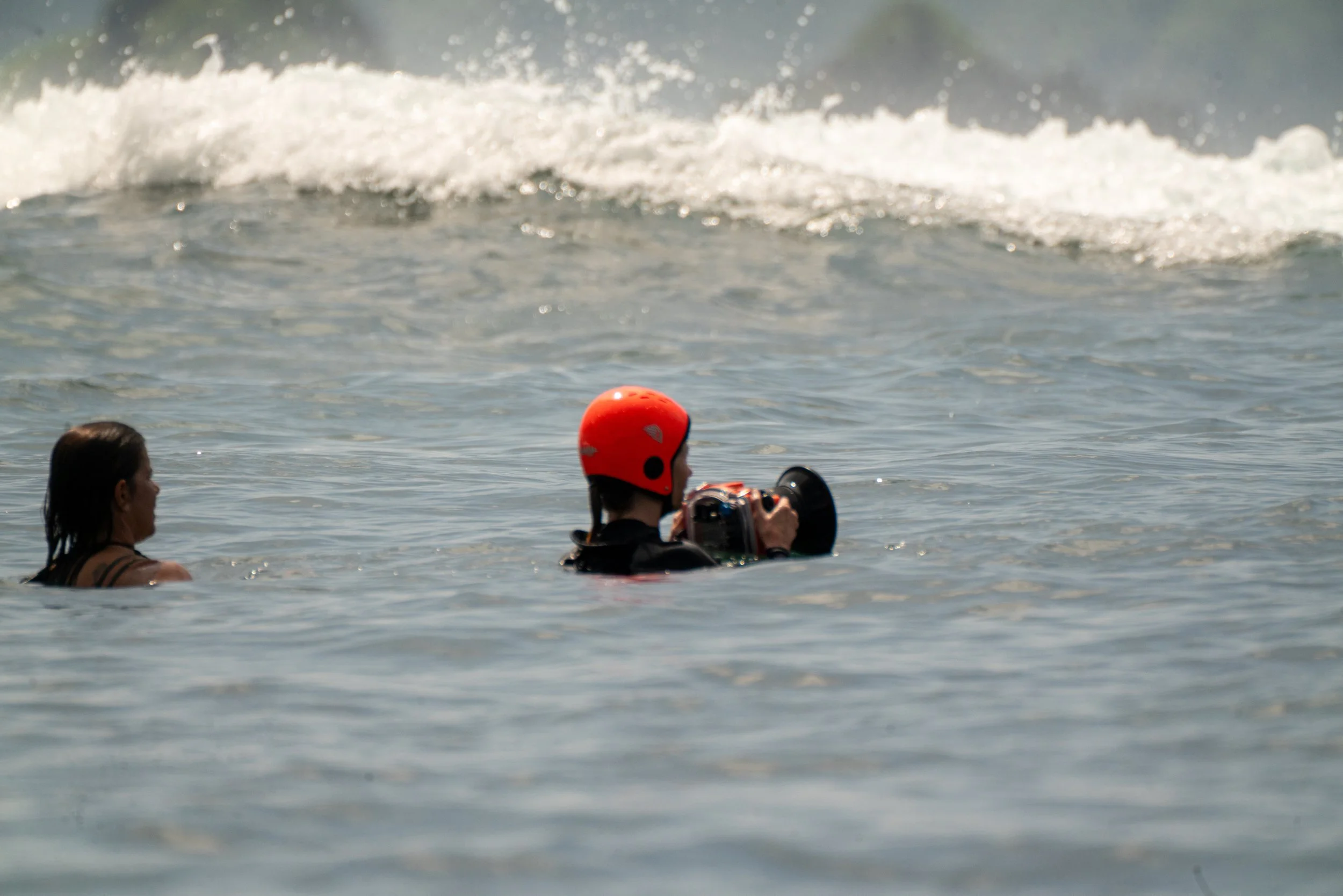
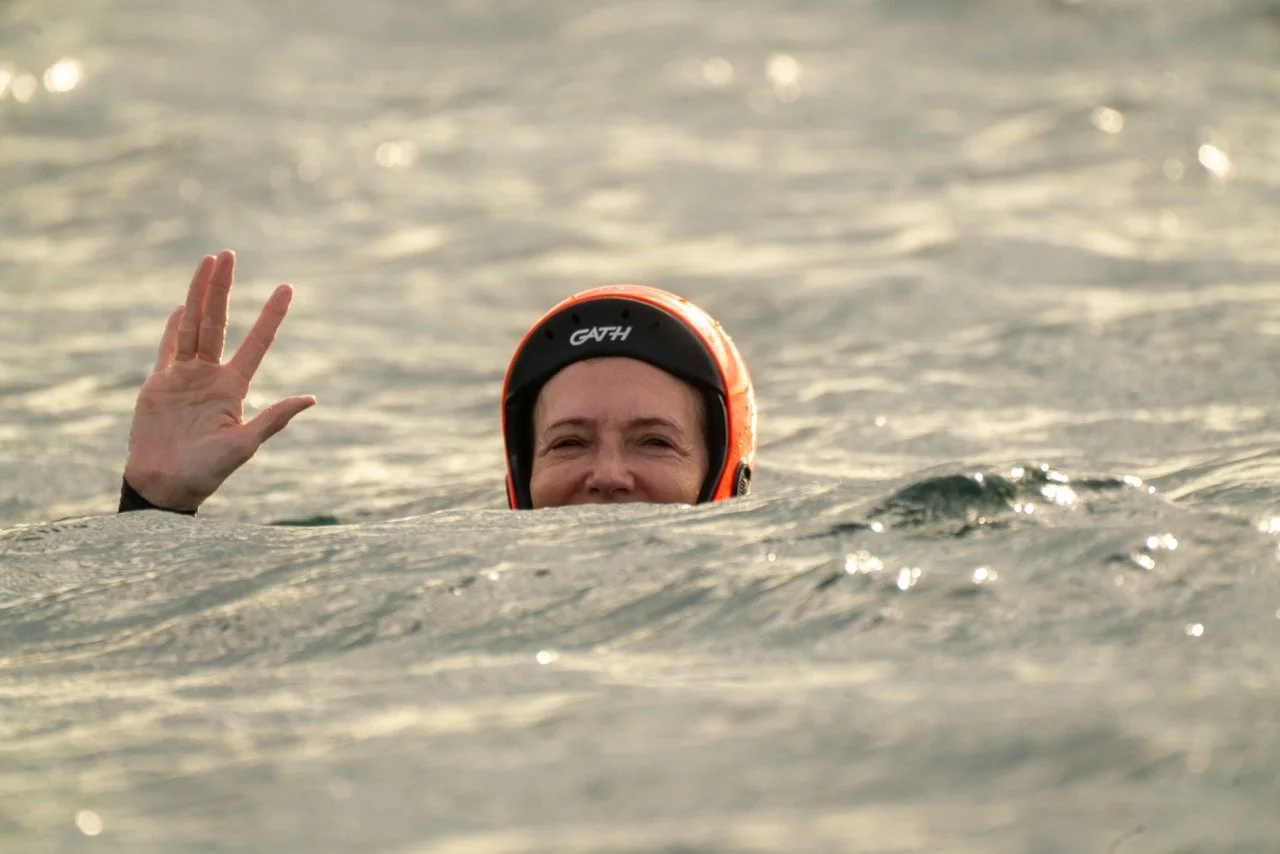
Rachel in the water with Ana Catarina by Life of Riley NYC


Tommy Pierucki sharing surf photography tips with Rachel. By Life of Riley NYC

Water Is Our Blood
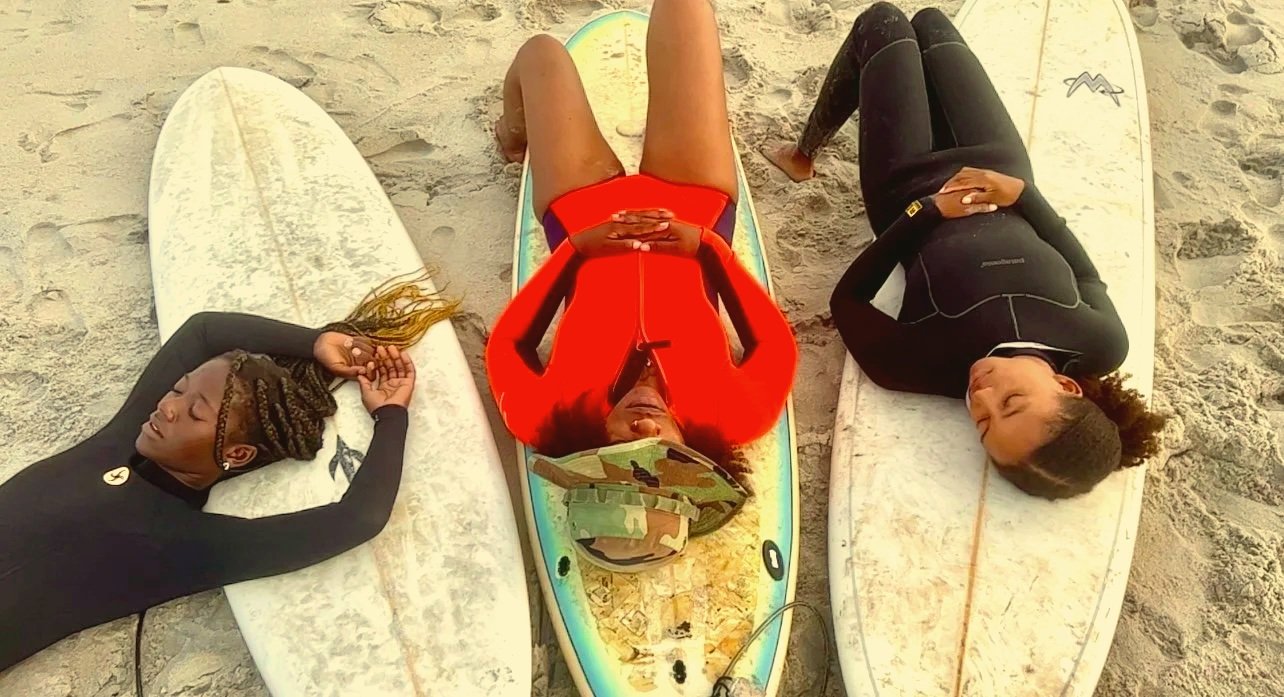
We feel safe with each other. So when we go out into the water, even though there can be that, you know, attitude when people see these beautiful Afrocentric Black women pop out, we're not as afraid or feeling like we have to prove ourselves anymore. Having that trust, it definitely translates into the water.

Figuring out a place in the line up helped three New York City surfers discover their place in the world.
This film is the story of a special sisterhood built on a love of water and waves. Three young surfers living in Rockaway Beach, New York City take a closer look at women building up and supporting other women while creating a community that shuts out all the noise and encourages a flow of freedom and positivity. These are the interviews we did before shooting anything. When we put them all together and read them as one, we knew at once we had something special.
How long have you been friends? Where and how did you all meet?
Farmy: I’ve been friends with Cyn for about 4 years and Autumn for about a year. I can't really remember the first time I met Cyn. I just remember her being at the beach with us all the time when Laru Beya first started and there was only a small crew of us. She was pushing us into waves, surfing with us, and also teaching us how to swim. Fun fact: when I first started surfing, I didn't really know how to swim. I could float and understood that my board was always there with me if anything happened. Cyn was the first person to really teach me how to move in the water. I remember going to the YMCA with her and 2 of the other mentees and she literally worked us to death between the workout and swim practice haha.
I met autumn randomly one day at the beach with Laru Beya in 2021. She came with Kwame and we never really spoke too much, just exchanged hellos. But in June, out of nowhere, we all randomly planned a last minute trip to Cali. Cyn, Autumn, our friend Elisabeth, and I all went and spent the weekend surfing as many places as we could, meeting up with friends, and just having a bunch of fun. After that trip we were stuck to each other's hips and got so much closer.

How does surfing play a role in your lives and in your friendship?
Cyn: Surfing was absolutely the glue that bonded us together. We met through Laru Beya, teaching the love of the water and surf to the youth beginning their own personal love for both. To be honest when we initially met we primarily worked together and rarely hung out outside of being on the beach. We had rough times just getting acclimated with the surf culture in Rockaway due to us being persons of color and then on top of that women. We definitely found solace in the fact that we could feel safer together out there in the water and just talk about it with each, not just because we were friends, but because we could each relate and be each other’s safe space to speak about it. We also used those same reasons to turn uncomfortable feelings to learning and teaching experiences as well as further motivation to not feel discouraged or stop what we knew belonged to us. Our love for the water, our love for the surf.
In what ways are the three of you alike?
Autumn: Our connection to surfing is something that really connects us all together. We all have a love for the ocean. We are all incredibly passionate about creating representation in the surf culture for the black community. Encouraging youth to get out in the water and making sure they know that they can participate in the sport of surf. Outside of water, I think we all love the idea of building community that is fun, vibrant and without bias.
In what ways are the three of you different?
We are incredibly different. I tend to be a bit more reserved compared to Cyn and Farmy. I love connecting one on one with people. Farmy is a great networker; she is so good at socializing and making friends. Cyn is so comfortable within herself and so outward in expression—it’s so beautiful. We all process and deal with things really differently. I’m always trying to process things in the moment and figure things out.
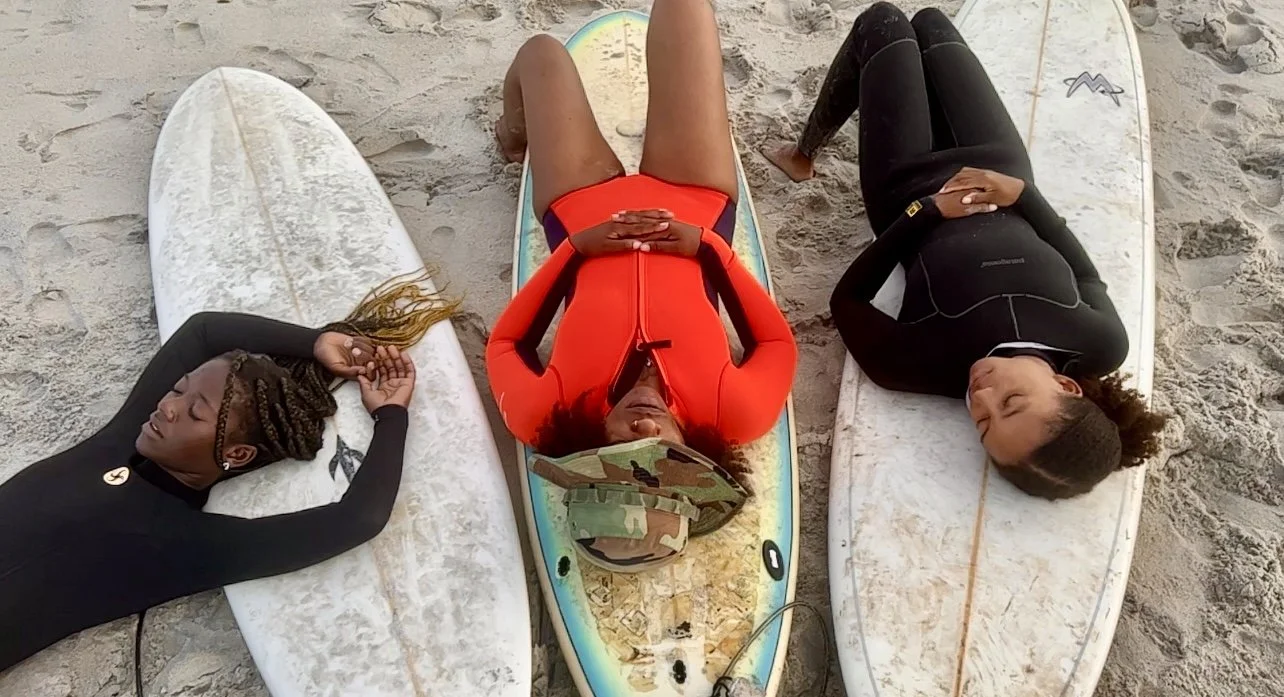
How does surfing play a role in your lives and in your friendship?
Everything good has stemmed from surfing. My life is centered around surfing, it is my life line. My life’s mirror. Surf is just like life. It can be hard, beautiful, and sad. Surfing is what brought us together. It’s what we do. It’s the heart.
As you look at your two friends, what would you say is their best quality?
Farmy: Cyn’s smile and her gap are her best features. To me it's my favorite, because it's what makes her so unique. Growing up i've met and seen so many people in my life feel insecure about their gaps or smiles. and the love Cyn has for hers shifted the way I think about my own personal beauty standards. Autumn’s best personality is her eyes. She can tell you thousands of stories without saying a single word. They're kinda like cats, I think, but always shining!! They say the eyes are the gates to the soul and if that's true hers is glowing bright :)
It’s really important to focus on the women in your lives, but it’s also important to acknowledge the men that support and mentor you. Who are some of these people and how do they support you and celebrate your wins?

Farmy: My parents have always inspired me. My father was a refugee who worked hard and moved our entire family over to the states. He's worked so many jobs, been an entrepreneur, and to this day is still working to build both the life that he wants and a legacy for our family. Aydon is another male in my life who has impacted me greatly. That’s probably why we call him surf dad. He’s guided me through my entire surf journey. Every step of the way, every new bridge I had to cross, every struggle I’ve endured in the water . . . Aydon was always there to support, to advise, to feed the girls and I, LMAO. I 100% wouldn’t be where I am today without him in my life.
I think it’s common to be jealous of others, even when they’re our friends. How do you three handle jealousy?
Autumn: When it comes to being friends with young women, there is a sense of competition that people are dealing with, and I feel like it ruins a lot of friendships. But with this, there's no competition. It's really support. Like we all just support every single win. But there is jealousy for sure. You know, like if someone is doing something amazing, I think it's a natural feeling to feel jealous, right? But we, me and Farmy talk about it a bunch, it’s like jealousy doesn't have to be this horrible thing. Our feelings are indicators and jealousy is an indication that someone is doing something that you would also like to do. You're receiving more information about yourself and then you can be like, wait, I'm friends with someone who's doing the coolest thing ever. So it's I'm supporting you, and also I'm inspired by you. You're doing things that I aspire to do.
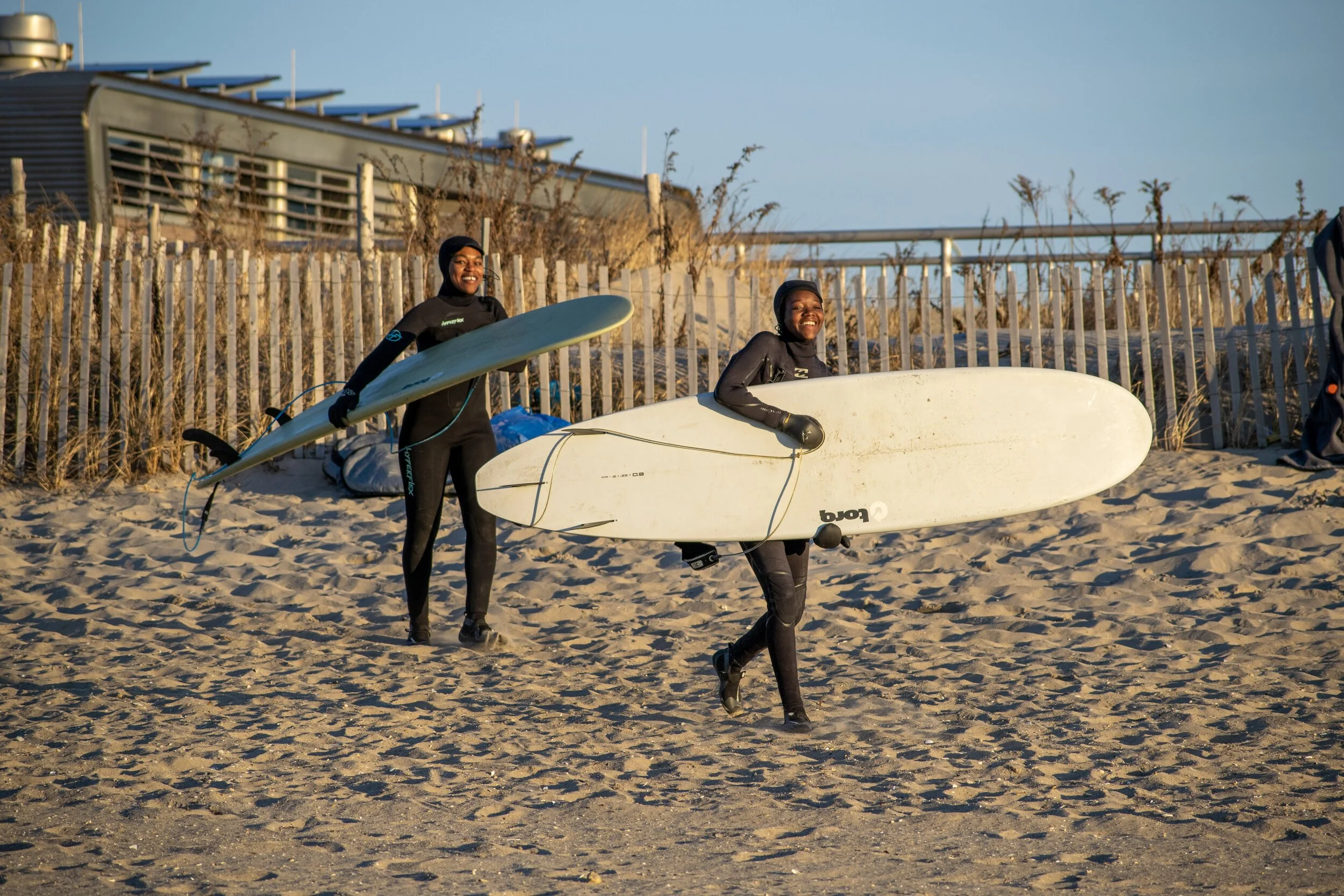
What is it like to live in Rockaway?
Cyn: Ten years? This is crazy. I'm in Rockaway for ten years. That's wild. But just coming from the Bronx to here it was such a culture shock, where I literally would be in my house, like having to look at my face in the mirror before I left. Like, all right, let me make sure that I have a good attitude because I would just walk through with my normal Bronx gameface on. People that didn't look like me, most of them, you know, not black and brown people, were asking me, “Are you okay? “ And I'm like, What do you mean by that? Mind you, you know, I interact at restaurants, you know, local places, and I would feel comfortable. I'm like, what's wrong? And they would say I just looked really angry. So I started adjusting like, this is a real community. You see the same exact faces every day. They're asking you about your family. Walking from corner to corner, you say hi to at least five people. I love that everyone's smiling, and that for me, before even in the surf, like just being able to go to the water, have fun with the people that literally live up and down the street. I don't have to worry about anything else. That was big for me. That was the best culture shock that I could say at this point that I ever had, that I needed because I was just so tough and hard. And it's like, Oh, everyone's still here. I know because the water is here. But now , you know, we have more than water.
What is it like to grow up in Rockaway?
Farmy: I’ve been in Rockaway for most of my life now. I hated it growing up, because I felt like there was never anything for me here. Once I started surfing, my own backyard became my playground and everything did a complete 180.
Who are some of the people that support you and celebrate your wins?
Cyn: Personally, I would start with the person that helped give me life, my father. I also feel Aydon, who is the founder of the organization Laru Beya I work with, has been pivotal in my growth, as well as I call him my ‘surf dad’ since I’ve been living in Rockaway. I also have my peers that I have met through surfing and the community in Rockaway. My dad has always, since I can remember; done everything in his power to ensure that I had access. As a young woman of color, a black girl growing up, that support and motivation was immensely powerful for me. I don’t know where I would be without him. Aydon, from the time I met him through teaching his children at the YMCA and him seeing something in me and allowing me to join Laru Beya and helping me pursue passion and dreams. Lastly my peers that I met through surfing have also encouraged me, and we’ve built long friendships thus far.
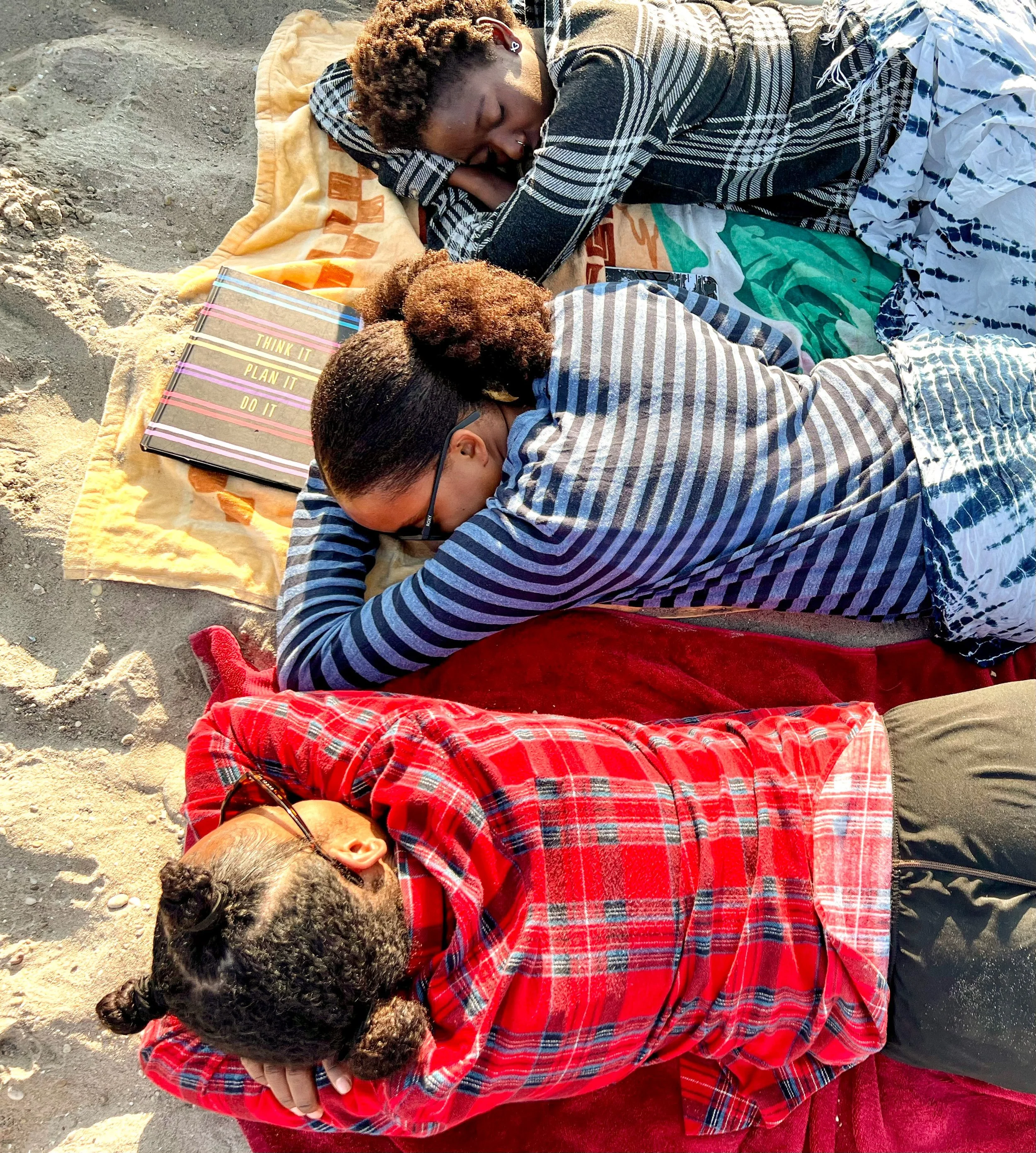
What’s the most inspiring thing someone has either said to you or done for you?
Farmy: During the Laru Beya shoot with Teen Vogue, Aydon said something along the lines of, “This is your break. You have every right to be in this water as much as anyone else. So take all your waves, paddle out where you want, and take up all the space that is yours.” and that’s been my mindset since.
What’s the best advice you’d give to other young females?
Autumn: Be exactly who you are in the moment. Celebrate who you are. Have goals. Work toward them. Build a community of women who support you in the life you want to live. But most importantly, be unapologetically you.
What’s the most valuable part of this sisterhood?
Cyn: We feel safe with each other. So when we go out into the water, even though there can be that, you know, attitude when people see these beautiful Afrocentric Black women pop out, we're not as afraid or feeling like we have to prove ourselves anymore. Having that trust, it definitely translates into the water. And having a safe space with each other. Also just relaxing on the beach, just being around each other. Honestly, sometimes we can hang out and not chat much, just in our own thoughts and check in like, Hey, you okay? Yeah. Yeah, I'm good. All right. The water is like, I don't know, our blood.


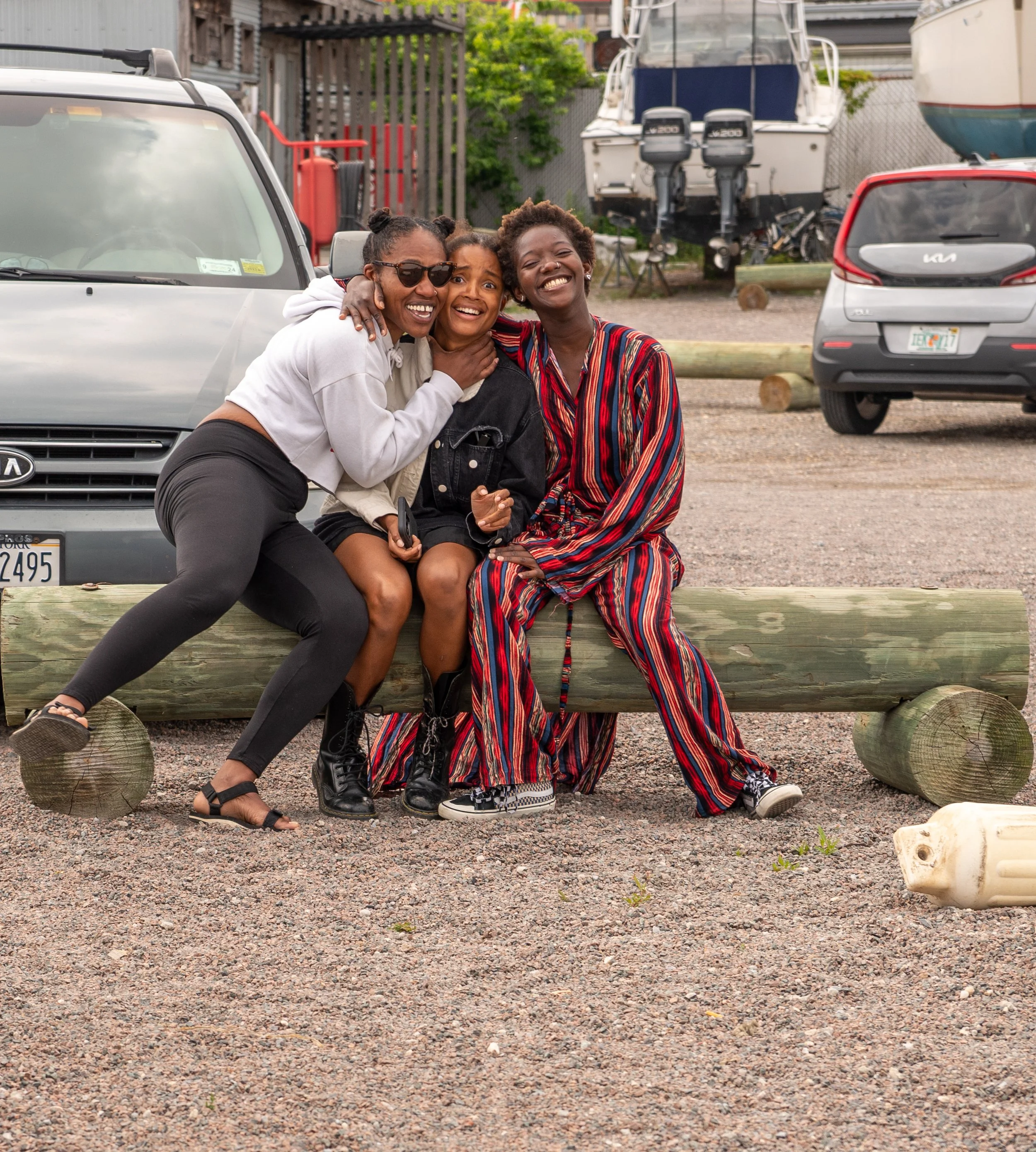


Living the Life of Riley
I moved out of the city and made my home in Rockaway, craving more of an outdoors lifestyle and the sweet sound of crashing waves. An empty nester, burned out, and emotionally distraught, I’d lost my way.
People always ask me what Life of Riley means. Simply put: It’s a declaration of living your best life. The concept was based on a 1944 radio show and later became a hit 1950’s TV show, The Life of Riley. People started using it as a common saying, that person is really living the Life of Riley, aka the good life. I first used Life of Riley as an artist name when I created my award-winning column at my college newspaper. It’s weird to say, but I became an instant sort of low-key “celebrity” around campus. Students started calling me Life of Riley or Riley. I’d get shout outs from strangers telling my what they enjoyed about my column or what it meant to them. I’d left my sales & marketing career behind in order to follow my dream of becoming a published writer. The end goal was an eventual MFA, and I wanted to write a book. So I attended college for the first time (I was a high school dropout.) at the age of 36. It was a huge leap of faith. I was scared a lot of the time, but writing the Life of Riley pushed me to explore and grow as a person and a creative. Those Life of Riley shout outs motivated me, maybe in a way nothing else ever had, and I savored each one. It was a sign that I was right where I belonged. That was life changing.
While in school, I joined the board of directors of a nonprofit. This was right at the beginning of social media. The nonprofit needed a Twitter account. I was the creative. So I learned all I could about Twitter and not only built that account but built the account of other locations’ social media. I really fell in love with the spontaneity, creativity, and even the crazy challenging algorithms. As a writer and a marketer, it came naturally. Once the word got around that I knew social media, other brands asked to hire me. So I started my own side hustle, Life of Riley Communications, a social media consulting company. I ended up growing a six figure business and made that my full-time career for almost a decade.

Five years ago, this past September, everything in my life changed. I moved out of the city and made my home in Rockaway, craving more of an outdoors lifestyle and the sweet sound of crashing waves. An empty nester, burned out, and emotionally distraught, I’d lost my way. Although I continued with a few clients, my heart was no longer in my business. I’d also started a book, but I realized at a certain point that I had run out of words. I picked up my camera that I normally used to create content for clients and started taking photos when I’d walk on the beach. At first it was seashells, seagulls, boats, and all the interesting beach characters. One chilly fall day, much like the weather as I’m writing this, a lone surfer caught my eye. It was just the two of us out there: not another soul in sight. I couldn’t look away and continued shooting, mesmerized by his long, smooth glide on the board and the hustle and flow of the Atlantic ocean. The sky opened itself up to me in a way it never had before. Oh what light! That dancing light even on a misty grey day took my breath away. I was reminded of days on the water when I was a kid, and how my little brother and I never wanted to get out or leave. And that was that. At 50, I reinvented myself as a surf and water photographer. Life of Riley NYC was born.

So, yeah, The Life of Riley means living your best life. But what does that even mean or look like really? I don’t have it all figured out. Hope I never do, honestly. I do know what I’ve discovered up to this point with all my Life of Riley iterations. I believe it means practicing self love or at least self like as often as possible. Recognizing daily joys like a sunrise. Connecting with people who support you and inspire you and reciprocating. Taking chances. Being gentle with yourself. Trusting the ebb and flow of life. Exploring where the comfort zone dead ends and adventure begins. Here’s to living your Life of Riley!


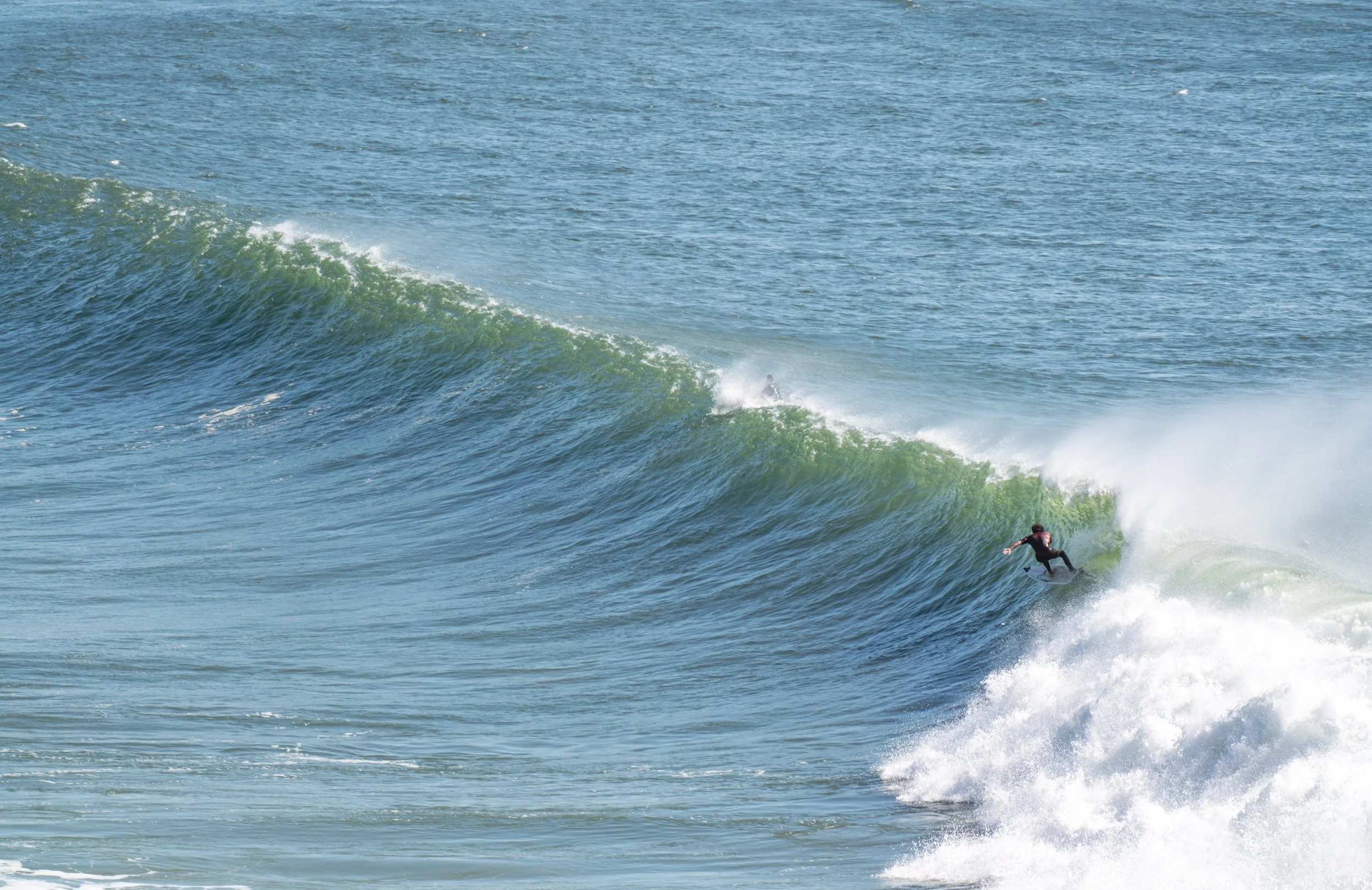


Love Comes In Waves
I wanted to know more about how a relationship with the ocean enhances a romantic relationship. I met Mike and Akiyo a few years ago. I’d see them on the beach and surfing solo or with friends and then started spotting them going out together.

When I first started noticing couples surfing together, I wanted to know more about how a relationship with the ocean enhances a romantic relationship? I met Mike and Akiyo a few years ago. I’d see them on the beach and surfing solo or with friends and then started spotting them going out together. I could tell immediately a beautiful friendship radiated at the core of their life together.
How long have you been together? How did you meet?
A: In 2014, we met at an art opening event at a friend’s shop, Nepenthes, in Midtown and became friends. We started dating at the end of 2017.
M: Me and Akiyo were friends before we became a couple. We met in 2014 at a friend's event in midtown. She said she just moved to NYC and was looking for people to surf with, and we said we were going surfing the next day. She showed up, and that was the beginning of our surf journey, which eventually led to us coupling up at the end of 2017.
Do you live in Rockaway or travel from the city to surf here?
M: We live in Brooklyn but actually lived in Long Beach, NY for 3 years before that.

What does surfing add to your life?
A: Excitement, life lessons, passion, appreciation, feeling blessed, socializing.
Before I got into it, I’d heard often that surfing is a lifestyle, and I wasn’t quite sure what that meant. Now I understand. It is really part of my life, our lives. I’m a hair and makeup artist, and I love it. My job and surfing are the main streams of my life.
M: Surfing is a pretty personal endeavor for me but to share waves and watch Akiyo get waves is exciting. I'm glad to have a partner who I hope can understand me. I'm lucky that she understands the froth and madness that comes with being engaged to surfing.

What does it bring to your relationship?
A: More excitement. More passion. More appreciation. More feeling blessed. I’m so happy and blessed that I have a partner who can share this lifestyle, passion and excitement. Surfing itself is already fun but with him everything becomes more!
How often do you surf together?
A: When we lived in Long Beach, it was like 4-5 times a week. Now probably 2-3 times a week.
M: We surf together as often as we are able. She, before we were even a pair, was the one partner I had who I could reliably call to go surfing because of her freelancing schedule and was game, even in the dead of winter. We even did the trifecta one year . . . that's surfing in the morning, snowboarding during the day, and skateboarding at night.

Did one of you introduce the other to surfing or did you both already know how to surf when you met?
A: I was a beginner when I met him. He already knew how to surf. He did introduce me to mid length/longboarding two to three years ago though. When we first met we only surfed short boards. Now we ride everything, depending on conditions.
M: When we first met, she was into surfing but kind of a beginner. I was surfing for a bunch of years but really not that good either.
What other activities do you enjoy doing together?
A: Snowboarding, skateboarding, going to events, and chilling at home.
M: We enjoy snowboarding together. We also love chilling at home, unwinding. We are pretty much home bodies and an occasional events couple.

During the pandemic how has life been different for you? Has it changed your relationship with surfing?
A: Less work, more surf. Less other activities, more surf. Less going out to the city, more surf. My work was slow or none at one point in 2020. So I had more time for surfing. I used to go to the climbing gym, but I stopped because of the Pandemic. Instead I surfed more!
I keep in touch with friends in Japan where I’m from, but it was only by SMS or when I traveled back to Japan before the Pandemic. During the pandemic I chatted more with them in Japan. That was a kind of nice thing that happened because of the pandemic. I was so grateful that I lived by the beach and could surf and socialize with other surfers when people really couldn’t socialize in person other than with house members.
M: During the pandemic, because we lived a couple blocks from the beach, we just surfed our brains out. I think for me personally, it's translated into my personal interest in surf craft and riding different boards more. Also, it's kept me pretty happy just staying local and trying to find something to ride, even when forecasts look bad. Just happy to be in the water, feel more connected to chaos, with a healthy dose of respect and wonder.




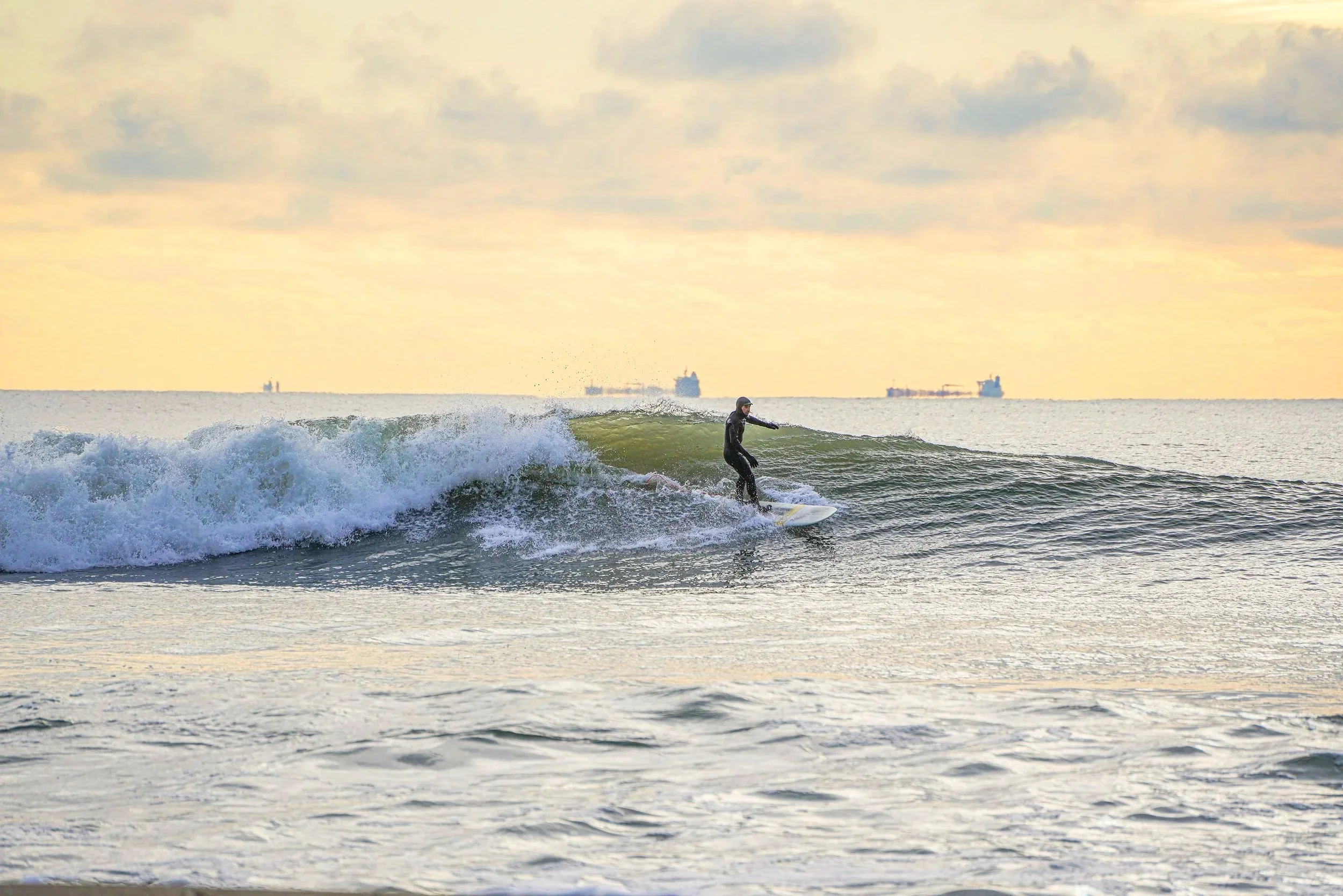
Love Will Prevail
There is a before and after Rockaway in my life. Same as there is a before and after my cancer.

Leandro Artigala
50, Artist, Architect, Surfer
Brooklyn, New York
Riley: When did you first start surfing?
Leandro: I started surfing when I was 15, thirty five years ago. Lucas, a good friend of mine, got me into surfing. At that time my friend was traveling every year, and for many years, together with his family to spend their summers in Brazil. A country where surfing was already very popular, particularly in comparison with Buenos Aires where the gap was pretty big for several reasons. First, Buenos Aires doesn’t have an ocean, just a huge river “Río de la Plata”, as a matter of fact the widest world wide. So in order for locals based in BA to get into the ocean they have to drive an average of 4 hours South, to the city of Mar del Plata, a beautiful place along the Atlantic. For this main reason, for many BA locals this was their summer destination city in the region. A city where surfing was already happening, not at the same pace as Brazil, but still. Basically Mar del Plata was the place where I did start and learn how to surf. The second important reason, and not the least, at that time (late 80’s) acquiring surfboards was very challenging and expensive. So Lucas not only gave me that first push literally, but let me use his wetsuits and boards, most of them traditional thrusters. Due to his Brazilian summer adventures, he was the guy with the largest quiver in town.
Riley: What places have you surfed? What makes Rockaway Beach stand out? Why does it hold a special place in your heart?
Leandro: I’ve surfed in Chile, Peru, Brazil, California, and Southern California. Unfortunately I didn't get the chance, nor had the money or the time to travel and explore more points and surfing locations. Anyway those particular destinations that I did get the chance to visit, marked an important time and memory in my life. Rockaway, same as Long Beach, are my favorite places in the world, not only for its surfing, but its formidable people.
Riley: How many boards do you have? Do you have a favorite?
Leandro: At the moment (together with my 16 year old son) we have a total of 6 boards (two longboards, a mid length, and three thrusters). My favorite, the Jose Barahona light blue mid length board, I got for my 50th birthday. I do love all of them.
Riley: Summer surf? Or winter surf? And why?
Leandro: Summer and winter, Surf all year around. Because I love it, surfing is one of my passions. And it truly helps me exponentially with my mental, physical and spiritual health.

Leandro and friend Takashi Yamada at the Community Paddle Out for Asian Solidarity in Rockaway Beach, New York.
Riley: You recently were diagnosed with cancer. You and I have had many conversations about it. I’ve treasured your openness. What did your world look like before the diagnosis? How has life changed since?
Leandro: I’ve already forgotten how my world looked (seven months ago) and how it was to feel well before my diagnosis. I feel like my life was put on hold, that someone took it away. Together with surfing, that’s what I really miss the most.
Riley: The surf community is like no other. I know I’m biased, but the Rockaway surf community is extra special. How has the community and your surf friends supported you during this time?
Leandro: There is a before and after Rockaway in my life. Same as there is a before and after my cancer. I can’t even imagine how it would be to transition into this new life, if I didn’t have Rockaway, if I didn’t have its community, if I didn’t have the friends and wonderful people that I was able to meet along these years through Rockaway.


Leandro’s son Lautaro out with his dad surfing Rockaway waves.
Riley: We met about 3 years ago. The first thing that stood out to me was watching you surf with your son, Lautaro. Why was that important to you? To share your love of surfing with your son. And what did you hope he would gain from your time together in the water?
Leandro: Surfing with my son is and means everything. Although it is quite hard to describe, put it into words and sum it up with one sentence. I’ve never pushed him or imposed it. At one point luckily enough Surfing for him was something quite natural, almost like walking. Without either of us noticing, all of a sudden we both ended up sitting on our boards at the lineup. I hope and believe he’ll get a lot out of the ocean, out of nature, out of surfing; his mind is already, and will literally blow up in such a good and amazing way. Nurturing him with life enriching, unforgettable and memorable experiences. Already touching our hearts and souls; our time in the water will live forever with us.
Riley: Leandro, two or three things you know for sure?
Leandro: Rather three words: “Love Will Prevail”
Leandro recently set up a GoFund Me page to help with all of the unexpected expenses since his cancer diagnosis. Please check it out and help if you can. Thank you.
